

A metrizable Choquet simplex is a nonempty compact set  in a real topological
vector space with a locally convex topology
satisfying the Hausdorff axioms, such that
in a real topological
vector space with a locally convex topology
satisfying the Hausdorff axioms, such that  is a convex
set and each
is a convex
set and each  has a unique representing probability measure
on its Borel sigma-algebra concentrated on
its extreme points. Here metrizability means that
the topology is induced by a metric.
If
has a unique representing probability measure
on its Borel sigma-algebra concentrated on
its extreme points. Here metrizability means that
the topology is induced by a metric.
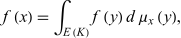
If  denotes the set of extreme points,
the representing measure
denotes the set of extreme points,
the representing measure  satisfies
 |
(1)
|
where  is any continuous function on
  that preserves convex combinations.
Such representing measures exist for every metrizable
compact set that is also a convex
set, but their uniqueness is an additional condition (Phelps 2001). This characterization
is stated for the metrizable case.
that preserves convex combinations.
Such representing measures exist for every metrizable
compact set that is also a convex
set, but their uniqueness is an additional condition (Phelps 2001). This characterization
is stated for the metrizable case.
Every finite-dimensional simplex has this property, since each point has unique weights in its convex combination of the polytope vertices. A square does not, since its center is the midpoint of either pair of opposite polytope vertices. The Poulsen simplex is an infinite-dimensional example whose extreme points form a dense set.
For a nonempty separable space  with a metric
  bounded by 1, choose a countable
set
bounded by 1, choose a countable
set  that is also a dense set in
  , and let
  be the set closure of
the convex hull of the distance profiles
be the set closure of
the convex hull of the distance profiles  in the product
space
in the product
space ![[0,1]^D](/images/equations/ChoquetSimplex/Inline14.svg) .
Sabok (2016, Question 9.4) asked whether this construction always gives a Choquet
simplex and whether the corresponding construction for the Urysohn
sphere gives the Poulsen simplex.
.
Sabok (2016, Question 9.4) asked whether this construction always gives a Choquet
simplex and whether the corresponding construction for the Urysohn
sphere gives the Poulsen simplex.
Zhang and Yang (2026a) reported negative answers to both questions. Their finite example is the cycle graph  with its graph distance
divided by 2. Its scaled graph distance matrix
is
with its graph distance
divided by 2. Its scaled graph distance matrix
is
![M=1/2[0 1 2 1; 1 0 1 2; 2 1 0 1; 1 2 1 0].](/images/equations/ChoquetSimplex/NumberedEquation2.svg) |
(2)
|
The four row vectors  ,
,  ,
,  , and
, and  are the polytope vertices
of a parallelogram and satisfy
are the polytope vertices
of a parallelogram and satisfy
 |
(3)
|
The two pairs therefore give distinct representing probability measures for the same point. Their Urysohn sphere argument also constructs distinct representing probability measures, but requires the full infinite-coordinate space rather than just this finite example.
The authors used GPT-based models to develop proof strategies and selected Lean components. As of Oct. 2, 2026, the Lean development verified finite and metric obstruction
arguments, but did not formalize the complete identification of  or the final Choquet and Poulsen
simplex conclusions. Independent specialist review of the complete arguments
had not been reported (Zhang and Yang 2026b, VibeMathed 2026).
or the final Choquet and Poulsen
simplex conclusions. Independent specialist review of the complete arguments
had not been reported (Zhang and Yang 2026b, VibeMathed 2026).

 -Algebras." Invent. Math. 204, 833-868,
2016.
-Algebras." Invent. Math. 204, 833-868,
2016.