

A Chebyshev node is one of a set of abscissas used for polynomial interpolation, obtained by
projecting equally spaced points on a semicircle
onto its diameter. The  roots of the Chebyshev
polynomial of the first kind
roots of the Chebyshev
polynomial of the first kind  give the node set
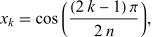 |
(1)
|
for  ,
...,
,
...,  .
These lie in
.
These lie in  and cluster toward the ends of the interval. They minimize
the maximum absolute value on
and cluster toward the ends of the interval. They minimize
the maximum absolute value on ![[-1,1]](/images/equations/ChebyshevNodes/Inline6.svg) of the monic polynomial
of the monic polynomial  , which appears
in the error formula for polynomial interpolation.
, which appears
in the error formula for polynomial interpolation.
Another common choice, often called Chebyshev-Lobatto points, includes both endpoints and uses the extrema of  ,
,
 |
(2)
|
for  ,
...,
,
...,  and
and  .
Both conventions are called Chebyshev nodes, so the node formula should be specified.
Nodes on a general interval
.
Both conventions are called Chebyshev nodes, so the node formula should be specified.
Nodes on a general interval ![[a,b]](/images/equations/ChebyshevNodes/Inline12.svg) are obtained from either set by the affine
transformation
are obtained from either set by the affine
transformation
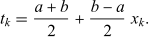 |
(3)
|
