

The autoconvolution supremum problem asks how small the essential supremum of the convolution of a nonnegative function with itself can be when its integral
and the length of a containing interval are fixed (Martin
and O'Bryant 2009, Matolcsi and Vinuesa 2010). Let  consist of the nonnegative integrable functions supported on
 with integral 1. The
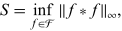
problem is to determine
 |
(1)
|
where  denotes the convolution of
 with itself and
 is the essential
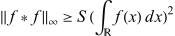
supremum norm. Equivalently,
 is the largest constant for which
 |
(2)
|
for every nonzero nonnegative integrable function  supported on this interval.
With support
 instead, the corresponding optimal constant
is
 by a change of scale.
In probabilistic terms, ](/images/equations/AutoconvolutionSupremumProblem/Inline10.svg) is the probability
density function of
 for
 ,
when
 and
 are independent and identically
distributed with probability density
function
 (Matolcsi and Vinuesa 2010).
An explicit step function gives an upper bound for  . If
 has nonnegative heights
 ,
 ,
...,
 , not all zero, on
 equal subintervals of
 ,
then
 |
(3)
|
where  outside
 . The maximum
can be evaluated at the breakpoints because the convolution
is a piecewise linear function (Martin
and O'Bryant 2009, Matolcsi and Vinuesa 2010).
Yuksekgonul et al. (2026) used AI-assisted search to find a 30,000-piece step function giving
 |
(4)
|
The autoconvolution inequality concerns a different ratio of norms, without this fixed-support restriction.
Ivanisvili and Xie (2026) refined the discretization estimate of Cloninger and Steinerberger (2017) to prove
 |
(5)
|
They report that Grok suggested the refinement. Atris Labs (2026) constructed a 65,536-piece step function with rational heights giving
 |
(6)
|
An improved lower bound for  also gives an improved upper bound
for the size of a generalized Sidon set.
The exact value remains unknown.
