


A piecewise linear function is a continuous function that is an affine function on each cell of a polyhedral subdivision of its domain. For a function of one real variable, the cells are intervals and the graph is a polygonal curve. The breakpoints of the intervals need not be equally spaced.
For example, let  . Linear interpolation
of the values
. Linear interpolation
of the values  gives a piecewise linear approximation to
  on
on ![[1,2]](/images/equations/PiecewiseLinearFunction/Inline4.svg) . The approximation improves as the mesh
size of the partition tends to zero. The trapezoidal
rule integrates this piecewise linear interpolant.
. The approximation improves as the mesh
size of the partition tends to zero. The trapezoidal
rule integrates this piecewise linear interpolant.
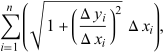
For a continuous piecewise linear function  with breakpoints
  , put
, put  and
and  . The exact arc
length of its graph is
. The exact arc
length of its graph is
 |
For a smooth function, the lengths of its piecewise linear interpolants converge under suitable refinement to
 |
The graph of a piecewise linear function of two variables on a polygonal domain is a piecewise-linear surface. The one-variable graph is its one-dimensional analog.
