

For  ,
the inverse
,
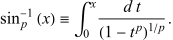
the inverse  -sine
is defined on
-sine
is defined on  by (Lindqvist 1995)
 |
(1)
|
The  -sine
-sine
 is the inverse function on the interval
  ,
where its quarter-period is
,
where its quarter-period is
 |  |  |
(2)
|
 |  |  |
(3)
|
 |  |  |
(4)
|
On this interval, the  -cosine is defined by
  . Extending the functions to the real line
by reflection and periodicity gives
. Extending the functions to the real line
by reflection and periodicity gives
 |
(5)
|
so 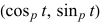 parameterizes the unit superellipse
 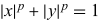 . When
  , these definitions reduce to the ordinary sine
and cosine and
, these definitions reduce to the ordinary sine
and cosine and  .
.
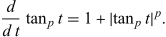
The  -tangent
is defined by
-tangent
is defined by  and satisfies
 |
(6)
|
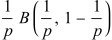
Consequently, the substitution  gives the improper
integral
gives the improper
integral
 |  |  |
(7)
|
 |  |  |
(8)
|
 |  |  |
(9)
|
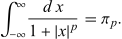
where  is the beta function. It follows by symmetry that
 |
(10)
|
(Poodiack 2026).
The term squigonometry is used for the broader study of analogues of trigonometry associated with
superellipses (Wood 2011, Poodiack and Wood 2022).
These  -trigonometric
functions should not be confused with the area-parameterized squigonometric
functions. Both systems parameterize the same unit superellipse,
but the defining inverse integrands have exponents
-trigonometric
functions should not be confused with the area-parameterized squigonometric
functions. Both systems parameterize the same unit superellipse,
but the defining inverse integrands have exponents  and
and  , respectively. The
  -trigonometric half-period
 ![pi_p=2pi/[psin(pi/p)]](/images/equations/p-TrigonometricFunctions/Inline39.svg) tends to 2 as
tends to 2 as  , whereas the constant denoted
  for the squigonometric functions is the area
  of the unit
  -circle
and tends to 4. The two conventions coincide when
-circle
and tends to 4. The two conventions coincide when  (Poodiack 2026).
