The beta function beta
integral (also called the Eulerian integral of the first kind). It is defined
by
(1)
The beta function Wolfram Language
as Beta a ,
b ].
To derive the integral representation of the beta function, write the product of
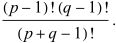
two factorials as
(2)
Now, let
Transforming to polar coordinates with
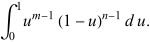
The beta function is then defined by
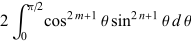
Rewriting the arguments then gives the usual form for the beta function,
By symmetry,
(13)
The general trigonometric form is
(14)
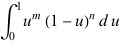
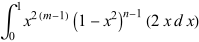
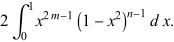
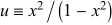
Equation (14 ) can be transformed to an integral over polynomials by letting
For any
(19)
(Krantz 1999, p. 158).
To put it in a form which can be used to derive the Legendre duplication formula , let
To put it in a form which can be used to develop integral representations of the Bessel functions and hypergeometric
function , let
(22)
In particular, the substitution reflection
relation give, for
Derivatives of the beta function are given by
where polygamma function .
Various identities can be derived using the Gauss
multiplication formula
Additional identities include
(34)
(35)
If positive
integer , then
(36)
In addition,
(37)
(38)
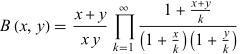
The beta function is also given by the product
(39)
(Andrews et al. 1999, p. 8).
Gosper gave the general formulas
(40)
for odd
(41)
which are an immediate consequence of the analogous identities for gamma functions . Plugging
(42)
(43)
See also Beta Integral ,
Central Beta Function ,
Dirichlet Beta Function ,
Dirichlet Integrals ,
Gamma
Function ,
Incomplete Beta Function ,
Regularized Beta Function
Related Wolfram sites https://functions.wolfram.com/GammaBetaErf/Beta/
Explore with Wolfram|Alpha
References Abramowitz, M. and Stegun, I. A. (Eds.). "Beta Function" and "Incomplete Beta Function." §6.2 and 6.6 in Handbook
of Mathematical Functions with Formulas, Graphs, and Mathematical Tables, 9th printing. Andrews, G. E.; Askey,
R.; and Roy, R. Special
Functions. Arfken,
G. "The Beta Function." §10.4 in Mathematical
Methods for Physicists, 3rd ed. Bailey, D. H.; Borwein, P. B.; and Plouffe, S. "On
the Rapid Computation of Various Polylogarithmic Constants." Math. Comput. 66 ,
903-913, 1997. Erdélyi, A.; Magnus, W.; Oberhettinger, F.; and
Tricomi, F. G. "The Beta Function." §1.5 in Higher
Transcendental Functions, Vol. 1. Jeffreys, H. and Jeffreys, B. S. "The Beta Function."
§15.02 in Methods
of Mathematical Physics, 3rd ed. Koepf, W. Hypergeometric
Summation: An Algorithmic Approach to Summation and Special Function Identities. Krantz, S. G.
"The Beta Function." §13.1.11 in Handbook
of Complex Variables. Morse,
P. M. and Feshbach, H. Methods
of Theoretical Physics, Part I. Press,
W. H.; Flannery, B. P.; Teukolsky, S. A.; and Vetterling, W. T.
"Gamma Function, Beta Function, Factorials, Binomial Coefficients" and
"Incomplete Beta Function, Student's Distribution, F-Distribution, Cumulative
Binomial Distribution." §6.1 and 6.2 in Numerical
Recipes in FORTRAN: The Art of Scientific Computing, 2nd ed. Spanier,
J. and Oldham, K. B. "The Incomplete Beta Function An
Atlas of Functions. Whittaker,
E. T. and Watson, G. N. A
Course of Modern Analysis, 4th ed. Referenced on Wolfram|Alpha Beta Function
Cite this as:
Weisstein, Eric W. "Beta Function." From
MathWorld https://mathworld.wolfram.com/BetaFunction.html
Subject classifications


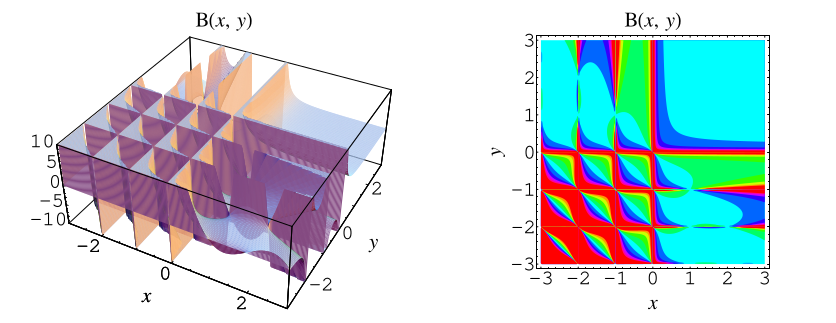
 is the name used by Legendre and Whittaker and Watson (1990) for the beta
integral (also called the Eulerian integral of the first kind). It is defined
by
is the name used by Legendre and Whittaker and Watson (1990) for the beta
integral (also called the Eulerian integral of the first kind). It is defined
by

 is implemented in the Wolfram Language
as Beta[a,
b].
is implemented in the Wolfram Language
as Beta[a,
b].

 ,
,
 , so
, so






 ,
, 


















 ,
,





 with
with ![Re[z_1],Re[z_2]>0](/images/equations/BetaFunction/Inline51.svg) ,
,

 , so
, so  and
and  , and
, and




 ,
so
,
so

 and the reflection
relation give, for
and the reflection
relation give, for  ,
,







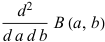
![B(a,b)[psi_0(a)-psi_0(a+b)]](/images/equations/BetaFunction/Inline72.svg)


![B(a,b)[psi_0(b)-psi_0(a+b)]](/images/equations/BetaFunction/Inline75.svg)


![B(a,b){[psi_0(b)-psi_0(a+b)]^2+psi_1(b)-psi_1(a+b)},](/images/equations/BetaFunction/Inline78.svg)


![B(a,b){[psi_0(a)-psi_0(a+b)]×[psi_0(b)-psi_0(a+b)]-psi_1(a+b)},](/images/equations/BetaFunction/Inline81.svg)
 is the polygamma function.


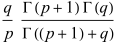




 is a positive
integer, then
is a positive
integer, then



![product_(i=0)^(2n)B(i/(2n+1)+a,i/(2n+1)+b)
=((2n+1)^((2n+1)/2)pi^nB(n,1/2[(b+a)(2n+1)+1])B(a(2n+1),b(2n+1)))/((n-1)!)](/images/equations/BetaFunction/NumberedEquation13.svg)
 , and
, and
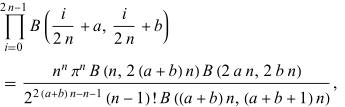
 and
and  into the above give the special cases

![B(a,b)B(a+1/4,b+1/4)B(a+1/2,b+1/2)B(a+3/4,b+3/4)=(2^(3-4(a+b))pi^2B(4a,4b))/((a+b)[1+4(a+b)]B(2(a+b),2(a+b+1))).](/images/equations/BetaFunction/NumberedEquation16.svg)

 ." Ch. 58 in