

The squigonometric functions are generalized sine and cosine functions that parameterize a unit superellipse
using twice the area of the swept sector.
For an integer  , they are initially defined in the first quadrant
by writing
, they are initially defined in the first quadrant
by writing  and
and  for the unique solutions of the coupled initial-value problem
![{x^'(t)=-[y(t)]^(n-1); y^'(t)=[x(t)]^(n-1); x(0)=1; y(0)=0.](/images/equations/SquigonometricFunctions/NumberedEquation1.svg) |
(1)
|
Differentiation then gives
 |
(2)
|
so  parameterizes the unit
  -circle
  . If
. If  denotes the area enclosed by this
curve, then the first quadrant is traversed as
denotes the area enclosed by this
curve, then the first quadrant is traversed as  runs from 0 to
  ,
and
,
and
 |  |  |
(3)
|
 |  |  |
(4)
|
where  is the beta function. In particular,
  as
as  .
.
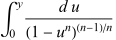
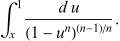
The inverse squigonometric functions on  are
are
 |  |  |
(5)
|
 |  |  |
(6)
|
Defining  and
and  gives
gives
 |  |  |
(7)
|
 |  |  |
(8)
|
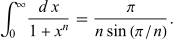
These identities make possible inverse squigonometric substitution. For example, Poodiack (2026) uses  together with the beta
function and reflection relation to obtain
the improper integral
together with the beta
function and reflection relation to obtain
the improper integral
 |
(9)
|
The squigonometric functions are distinct from the p-trigonometric functions. At  , both systems trace the same unit superellipse,
but the defining inverse integrand for the
, both systems trace the same unit superellipse,
but the defining inverse integrand for the  -sine has exponent
  instead of
  . Its half-period
 ![2pi/[nsin(pi/n)]](/images/equations/SquigonometricFunctions/Inline39.svg) tends to 2, whereas the squigonometric constant
tends to 2, whereas the squigonometric constant
 is the area of the unit
  -circle and tends to 4. The two systems agree when
  .
.
