


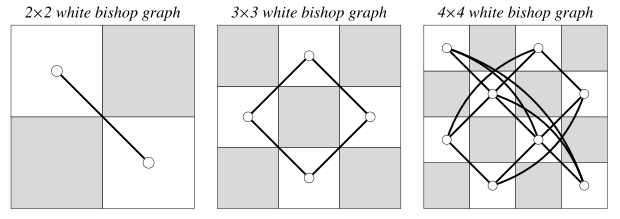
A white bishop graph is a graph formed from possible moves of a bishop chess piece, which may make diagonal moves of any length on a chessboard (or any other board), when starting from a white square on the board. To form the graph, each chessboard square is considered a vertex, and vertices connected by allowable bishop moves are joined by edges.
The  -white
bishop graph is the induced subgraph of the general
-white
bishop graph is the induced subgraph of the general
 -bishop
graph on the white squares. It is isomorphic to the
-bishop
graph on the white squares. It is isomorphic to the
 -black
bishop graph unless both
-black
bishop graph unless both  and
and  are odd.
Note that here, "white" and "black" refer to the color of the squares a given bishop moves on irrespective of the color of the bishop piece itself.
Since the  chessboard consists of a single black square,
the
chessboard consists of a single black square,
the  white bishop graph is the null graph.
Special cases are summarized in the following table, where  is the floor function.


 -
-