

A uniquely Hamiltonian graph is a graph possessing a single Hamiltonian cycle. The enumerations and results below concern finite undirected simple graphs.
Classes of uniquely Hamiltonian graphs include the cycle graphs  , Hanoi graphs
 , ladder graphs
 (for
 ), complete sun graphs,
and uniquely pancyclic graphs with at
least three vertices.
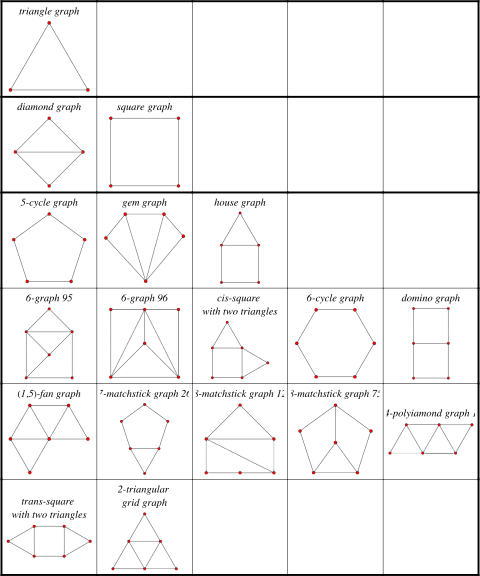
The numbers of uniquely Hamiltonian graphs on  ,
2, ... are 0, 0, 1, 2, 3, 12, 49, 482, 6380, ... (OEIS A307956;
Goedgebeur et al. 2019, Table 4) and the corresponding numbers of planar
uniquely Hamiltonian graphs are 0, 0, 1, 2, 3, 12, 49, 460, 4994, ... (OEIS A307957;
Goedgebeur et al. 2019, Table 1).
A Hamiltonian cubic graph contains at least three Hamiltonian cycles, so there are no uniquely Hamiltonian cubic graphs (Goedgebeur et al. 2019).
Fleischner (2014) constructed uniquely Hamiltonian graphs in which every vertex has vertex degree 4 or 14. His smallest examples with vertex connectivity 2 and 3 have 338 and 408 vertices, respectively (Fleischner 2014, Goedgebeur et al. 2019). In this work, graphs related to this construction are known as Fleischner graphs.
Barefoot and Entringer (1981) proved that for every  , there exist exactly
 uniquely Hamiltonian graphs of maximum edge
count (Goedgebeur et al. 2019), where
 is the ceiling function.
Liu et al. (2026) proved that every  -regular Hamiltonian
graph with
 has a second Hamiltonian
cycle, improving the earlier threshold 23 (Haxell et al. 2007). The existence
of a 4-regular uniquely Hamiltonian graph remains open (Brinkmann and De Pauw 2024).

 -Regular Hamiltonian Graph with
 Contains a Second Hamilton Cycle." 4 Nov 2026.