


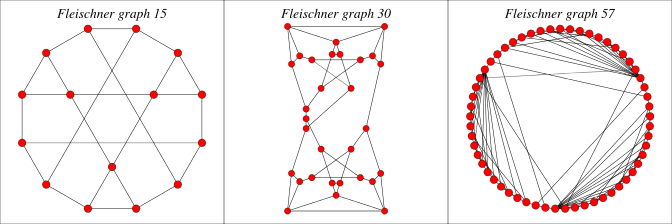
The term "Fleischner graphs" is used in this work for graphs arising in the construction by Fleischner (2014) of uniquely Hamiltonian graphs of minimum vertex degree 4. In particular, he constructed uniquely Hamiltonian graphs in which every graph vertex has vertex degree 4 or 14. His smallest examples with vertex connectivity 2 and 3 have 338 and 408 vertices, respectively (Fleischner 2014, Goedgebeur et al. 2019).
The graph with 338 vertices begins with a graph  on 15 vertices and 24
edges that has two Hamiltonian
cycles, then builds up a series of graphs
on 15 vertices and 24
edges that has two Hamiltonian
cycles, then builds up a series of graphs  ,
,  , and
, and  in which each
  has
has  vertices,
  edges, and two Hamiltonian
cycles. He then defines
edges, and two Hamiltonian
cycles. He then defines  and
and  by removing the vertices
  and
and  of vertex degree 3. A further
construction removes
of vertex degree 3. A further
construction removes  and
and  in
in  (Knuth 2025, p. 17 and Exercise 120). The culmination of this process is a graph
  on 338 vertices having a
unique Hamiltonian cycle.
on 338 vertices having a
unique Hamiltonian cycle.
Fleischner also constructed a uniquely Hamiltonian graph on 30 vertices used in the proof
that infinitely many k-connected graphs
with  are uniquely Hamiltonian and have minimum vertex degree 4 (Fleischner 2014).
The Fleischner graphs on 15 and 30 vertices have graph crossing number 2 and 4, respectively.
Some of the graphs discussed above are implemented in the Wolfram Language as GraphData["FleischnerGraph15"], GraphData["FleischnerGraph30"], GraphData["FleischnerGraph57"], GraphData["FleischnerGraph169"], and GraphData["FleischnerGraph338"].
