

Uniform sampling is the selection of random outcomes with probabilities proportional to size as specified by a chosen measure.
Given a measurable set  and a measure
  with
with  , a sampled random
variable
, a sampled random
variable  satisfies
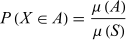 |
for every measurable set  . This defines a probability
measure on
. This defines a probability
measure on  (Random Services).
For a nonempty finite set of  elements, assigning size 1 to each element gives probability
  for each choice, as in a discrete
uniform distribution. On an interval, using length gives the usual uniform
distribution. In geometric point picking, size
may instead be area, surface
area, or volume (Devroye 1986, pp. 567-571).
for each choice, as in a discrete
uniform distribution. On an interval, using length gives the usual uniform
distribution. In geometric point picking, size
may instead be area, surface
area, or volume (Devroye 1986, pp. 567-571).
The choice of measure matters. For example, disk point picking uses area, so choosing a radius from a uniform distribution does not produce uniform sampling of the disk. Similarly, cylinder point picking distinguishes surface area from volume.
