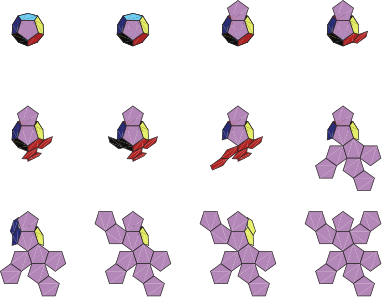
An unfolding is the cutting along edges and flattening out of a polyhedron to form a net. Determining how to unfold a polyhedron into
a net is tricky. For example, cuts cannot be made along all edges that surround
a face or the face will completely separate. Furthermore, for a polyhedron with no
coplanar faces, at least one edge cut must be made from each vertex or else the polyhedron
will not flatten. In fact, the edges that must be cut corresponds to a special kind
of graph called a spanning tree of the skeleton
of the polyhedron (Malkevitch).
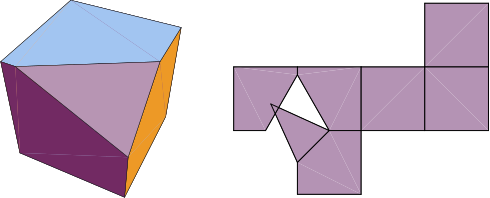
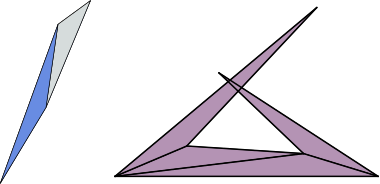
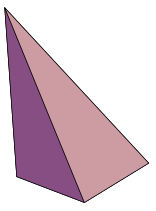
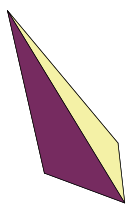
In 1987, K. Fukuda conjectured that no convex polyhedra admit a self-overlapping unfolding. The top figure above shows a counterexample to the conjecture found by M. Namiki. An unfoldable tetrahedron was also subsequently found (bottom figure above). Another nonregular convex polyhedra admitting an overlapping unfolding was found by G. Valette (shown in Buekenhout and Parker 1998).
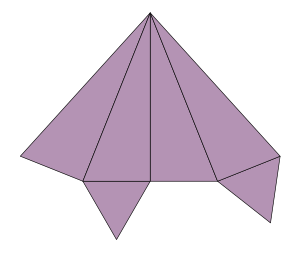
Examples of different polyhedra that can be constructed from the same net are not difficult to construct, but Fukuda conjectured that every convex
polyhedron can be uniquely constructed from any of its unfoldings. The counterexample
shown above was found by T. Matsui.
The question of whether every convex polyhedron admits a self-unoverlapping unfolding (Shephard 1975) is still unsettled (Malkevitch).
Shephard's conjecture states (and most mathematicians
believe) that the answer is yes.
Cuts other than along edges of the polyhedron can also be considered. For example, a star unfolding is a way of unfolding a polyhedron by cutting along shortest paths on the surface of it. Aronov and Rourke (1992) showed that every convex 3-dimensional polyhedron has a star unfolding (Malkevitch).
One way to restrict the choice of cuts is to require the surface to open along a single path, producing one continuous strip. In a zipper unfolding, this path is
a cut path, and an edge-cut zipper unfolding is a Hamiltonian unfolding. Every Platonic solid and Archimedean
solid has such an unfolding (Demaine et al. 2010). A spiral unfolding
adds the geometric condition that the strip wind around the polyhedron. Every Platonic solid and Archimedean
solid also has a nonself-intersecting spiral unfolding (O'Rourke 2015).
Apple-peel fold-outs are spiral strips inspired by the shape left when an apple is peeled. Kimura et al. (2015) constructed apple-peel fold-outs for regular
four-dimensional polytopes. Yoshino and Chaidee (2026)
subsequently formulated apple-peel unfolding as a greedy traversal beginning with
an ordered pair of adjacent faces or cells.
Their spiral rule selects the sharpest clockwise turn using a signed determinant,
while their zonal rule selects the candidate having greatest coordinate along the
peeling axis. Completing such a traversal does not guarantee a valid net,
since the resulting strip may self-intersect.
Agarwal, P.; Aronov, B.; O'Rourke, J.; and Schevon, C. "Star Unfolding of a Polytope with Applications." SIAM J. Comput.26,
1689-1713, 1997.Aronov, B. and O'Rourke, J. "Nonoverlap of the
Star Unfolding." Disc. Comput. Geom.8, 219-250, 1992.Bern,
M.; Demaine, E. D.; Eppstein, D.; and Kuo, E. "Ununfoldable Polyhedra."
Proc. 11th Canadian Conference on Computational Geometry, pp. 13-16,
1999. Preprint dated 3 Aug 1999 available from https://arxiv.org/abs/cs/9908003.Biedl,
T.; Demaine, E.; Demaine, M.; Lubiw, A.; O'Rourke, J.; Overmars, M.; Robbins, S.;
and Whitesides, S. "Unfolding Some Classes of Orthogonal Polyhedra." In
Proc. 10th Canadian Conference on Computational Geometry, pp. 70-71,
1998.Bouzette, S.; Buekenhout, F.; Dony, E.; and Gottcheiner, A. "A
Theory of Unfoldings for Polyhedra and Polytopes Related to Incidence Geometries."
Designs, Codes and Cryptography10, 115-136, 1997.Buekenhout,
F. and Parker, M. "The Number of Nets of the Regular Convex Polytopes in Dimension
." Disc. Math.186,
69-94, 1998.Demaine, E. D.; Demaine, M. L.; Lubiw, A.; Shallit,
A.; and Shallit, J. L. "Zipper Unfoldings of Polyhedral Complexes."
In Proc. 22nd Canadian Conference on Computational Geometry, pp. 219-222,
2010. https://erikdemaine.org/papers/Zippers_CCCG2010/.Eppstein,
D. "Unfolded Polyhedra." https://ics.uci.edu/~eppstein/junkyard/unfold.html.Erickson,
J. "Unfolding Convex Polytopes." http://compgeom.cs.uiuc.edu/~jeffe/open/unfold.html.Fukuda,
K. "Strange Unfoldings of Convex Polytopes." https://people.inf.ethz.ch/fukudak/unfold_home/unfold_open.html. Fukuda, K. UnfoldPolytopeMathematica packages. https://web.archive.org/web/20230410085138/https://www.cs.mcgill.ca/~fukuda/download/mathematica/.Kimura,
Y.; Kaino, K.; and Okumura, T. "Apple-Peel Fold-Outs of Four-Dimensional Polytope
and Its CG Image Generation."
The Journal of the Society for Art and Science14, 73-82, 2015. https://doi.org/10.3756/artsci.14.73.Lubiw,
A. and O'Rourke, J. "When Can a Polygon Fold to a Polytope?" Technical
Report 48, Department of Computer Science, Smith College, June, 1996.Malkevitch,
J. "Le géométrie et la paire de ciseaux." La Recherche.
No. 346, Oct. 2001. http://www.larecherche.fr/special/web/web346.html.Malkevitch,
J. "Nets: A Tool for Representing Polyhedra in Two Dimensions." https://www.ams.org/publicoutreach/feature-column/fcarc-nets.Malkevitch,
J. "Unfolding Polyhedra." https://web.york.cuny.edu/~malk/unfolding.html. Namiki, M.; Matsui, T.; and Fukuda, K. "3-Polytopes with Bad Unfoldings."
In UnfoldPolytopeMathematica packages. 1993. https://web.archive.org/web/20230410085138/https://www.cs.mcgill.ca/~fukuda/download/mathematica/.O'Rourke,
J. "Folding and Unfolding in Computational Geometry." In Proc. Japan
Conference on Discrete and Computational Geometry 1998. Heidelberg, Germany:
Springer-Verlag, pp. 258-266, 2000.O'Rourke, J. "Spiral Unfoldings
of Convex Polyhedra." Oct. 19, 2015. https://arxiv.org/abs/1509.00321.Schevon,
C. and O'Rourke, J. "A Conjecture on Random Unfoldings." Technical Report
JHU-87/20. Baltimore, MD: Johns Hopkins University, 1987.Shephard, G. C.
"Convex Polytopes with Convex Nets." Math. Proc. Camb. Phil. Soc.78,
389-403, 1975.Tarasov, A. "Polyhedra with No Natural Unfolding."
Russian Math. Surveys54, 656-657, 1999.Yoshino, T. and
Chaidee, S. "Apple-Peel Unfolding in Three and Four Dimensions: Spiral and Zonal
Selection Rules." May 22, 2026. https://arxiv.org/abs/2605.30373. Yoshino, T. and Chaidee, S. "Apple-Peel Unfolding in Three and Four
Dimensions." GitHub repository. https://github.com/takashi-randomwalker/apple-peel-4d.



 ." Disc. Math. 186,
69-94, 1998.Demaine, E. D.; Demaine, M. L.; Lubiw, A.; Shallit,
A.; and Shallit, J. L. "Zipper Unfoldings of Polyhedral Complexes."
In Proc. 22nd Canadian Conference on Computational Geometry, pp. 219-222,
2010.
." Disc. Math. 186,
69-94, 1998.Demaine, E. D.; Demaine, M. L.; Lubiw, A.; Shallit,
A.; and Shallit, J. L. "Zipper Unfoldings of Polyhedral Complexes."
In Proc. 22nd Canadian Conference on Computational Geometry, pp. 219-222,
2010.  Fukuda, K. UnfoldPolytope Mathematica packages.
  and Its CG Image Generation."
The Journal of the Society for Art and Science 14, 73-82, 2015.
and Its CG Image Generation."
The Journal of the Society for Art and Science 14, 73-82, 2015.