


Twin primes are pairs of primes of the form ( ,
,
 ). The term "twin prime"
was coined by Paul Stäckel (1862-1919; Tietze 1965, p. 19). The first few
twin primes are
). The term "twin prime"
was coined by Paul Stäckel (1862-1919; Tietze 1965, p. 19). The first few
twin primes are  for
for  , 6, 12, 18, 30, 42, 60, 72, 102, 108,
138, 150, 180, 192, 198, 228, 240, 270, 282, ... (OEIS A014574).
Explicitly, these are (3, 5), (5, 7), (11, 13), (17, 19), (29, 31), (41, 43), ...
(OEIS A001359 and A006512).
, 6, 12, 18, 30, 42, 60, 72, 102, 108,
138, 150, 180, 192, 198, 228, 240, 270, 282, ... (OEIS A014574).
Explicitly, these are (3, 5), (5, 7), (11, 13), (17, 19), (29, 31), (41, 43), ...
(OEIS A001359 and A006512).
All twin primes except (3, 5) are of the form  .
.
It is conjectured that there are an infinite number of twin primes (this is one form of the twin prime conjecture), but proving this remains one of the most elusive open problems in number theory. An important result for twin primes is Brun's theorem, which states that the number obtained by adding the reciprocals of the odd twin primes,
 |
(1)
|
converges to a definite number ("Brun's constant"), which expresses the scarcity of twin primes, even if there are infinitely many of
them (Ribenboim 1996, p. 201). By contrast, the series of all prime reciprocals
diverges to infinity, as follows from the Mertens
second theorem by letting  .
.
The proved theorem on bounded gaps between primes gives infinitely many pairs of consecutive primes separated by at most 246 (Polymath 2014). It does not prove that infinitely many pairs are separated by exactly 2, so the twin prime conjecture remains open.
The following table gives the first few  for the twin primes (
 ,
,  ),
cousin primes (
),
cousin primes ( ,
,  ),
sexy primes (
),
sexy primes ( ,
,  ),
etc.
),
etc.
| pair | OEIS | first member |
( , ,  ) ) | A001359 | 3, 5, 11, 17, 29, 41, 59, 71, ... |
( , ,  ) ) | A023200 | 3, 7, 13, 19, 37, 43, 67, 79, ... |
( , ,  ) ) | A023201 | 5, 7, 11, 13, 17, 23, 31, 37, ... |
( , ,  ) ) | A023202 | 3, 5, 11, 23, 29, 53, 59, 71, ... |
( , ,  ) ) | A023203 | 3, 7, 13, 19, 31, 37, 43, 61, ... |
( , ,  ) ) | A046133 | 5, 7, 11, 17, 19, 29, 31, 41, ... |
Let  be the number of twin primes
  and
and  such that
  . It is not known if there are an infinite number of
such primes (Wells 1986, p. 41; Shanks 1993),
but it seems almost certain to be true (Hardy and Wright 1979, p. 5).
. It is not known if there are an infinite number of
such primes (Wells 1986, p. 41; Shanks 1993),
but it seems almost certain to be true (Hardy and Wright 1979, p. 5).
Chen's theorem shows that there are infinitely many primes  such that
  is either a prime or a semiprime
(Chen 1973). Brun proved that there exists a computable integer
is either a prime or a semiprime
(Chen 1973). Brun proved that there exists a computable integer  such that if
  , then
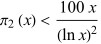 |
(2)
|
(Ribenboim 1996, p. 261). It has been shown that
![pi_2(x)<=cproduct_(p>2)[1-1/((p-1)^2)]x/((lnx)^2)[1+O((lnlnx)/(lnx))],](/images/equations/TwinPrimes/NumberedEquation3.svg) |
(3)
|
written more concisely as
![pi_2(x)<=cPi_2x/((lnx)^2)[1+O((lnlnx)/(lnx))],](/images/equations/TwinPrimes/NumberedEquation4.svg) |
(4)
|
where  is known as the twin primes constant and
  is another constant. The constant
  has been reduced to
  (Fouvry and Iwaniec 1983),
  (Fouvry 1984), 7 (Bombieri et al. 1986),
6.9075 (Fouvry and Grupp 1986), 6.8354 (Wu 1990), and 6.8325 (Haugland 1999). The
latter calculation involved evaluation of 7-fold integrals and fitting of three different
parameters.
(Fouvry 1984), 7 (Bombieri et al. 1986),
6.9075 (Fouvry and Grupp 1986), 6.8354 (Wu 1990), and 6.8325 (Haugland 1999). The
latter calculation involved evaluation of 7-fold integrals and fitting of three different
parameters.
Hardy and Littlewood (1923) conjectured that  (Ribenboim 1996, p. 262), and that
  is asymptotically equal to
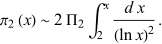 |
(5)
|
This result is sometimes called the strong twin prime conjecture and is a special case of the k-tuple conjecture. A necessary (but not sufficient) condition for the twin prime conjecture to hold is that the prime gaps constant, defined by
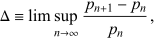 |
(6)
|
where  is the
  th
prime and
th
prime and 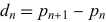 is the prime difference function, satisfies
 .
.
Wolf notes that the formula
![pi_2(x)∼2Pi_2([pi(x)]^2)/x,](/images/equations/TwinPrimes/NumberedEquation7.svg) |
(7)
|
(which has asymptotic growth 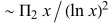 ) agrees with numerical data much better than
does
) agrees with numerical data much better than
does  , although not as well as
 .
.
Extending the search done by Brent in 1974 or 1975, Wolf has searched for the analog of the Skewes number for twins, i.e., an  such that
  changes sign. Wolf checked numbers up to
 and found more than
  sign changes. From this data, Wolf conjectured that the
number of sign changes
sign changes. From this data, Wolf conjectured that the
number of sign changes  for
for  of
of  is given by
 |
(8)
|
Proof of this conjecture would also imply the existence an infinite number of twin primes.
The largest known twin-prime pair as of Aug. 2026 is
 |
(9)
|
whose members each have  decimal digits. Tom Greer found the pair as part of PrimeGrid in Sep. 2016 (PrimeGrid
2016, PrimePages 2026).
decimal digits. Tom Greer found the pair as part of PrimeGrid in Sep. 2016 (PrimeGrid
2016, PrimePages 2026).
In 1995, Nicely discovered a flaw in the Intel® Pentium™ microprocessor by computing the reciprocals of  and
and  , which should have been accurate to 19 decimal
places but were incorrect from the tenth decimal place on (Cipra 1995, 1996; Nicely
1995).
, which should have been accurate to 19 decimal
places but were incorrect from the tenth decimal place on (Cipra 1995, 1996; Nicely
1995).
If  , the integers
  and
and  form a pair of twin primes iff
![4[(n-1)!+1]+n=0 (mod n(n+2)).](/images/equations/TwinPrimes/NumberedEquation10.svg) |
(10)
|
 where
where  is a pair of twin primes iff
 |
(11)
|
(Ribenboim 1996, p. 259). S. M. Ruiz has found the unexpected result that  are twin primes iff
 |
(12)
|
for  , where
  is the floor function.
The values of  were found by Brent (1976) up to
  . T. Nicely calculated them up to
  in his calculation of Brun's
constant. Fry et al. (2001) and Sebah (2002) independently obtained
in his calculation of Brun's
constant. Fry et al. (2001) and Sebah (2002) independently obtained  using distributed computation.
Later computations extended the values through
using distributed computation.
Later computations extended the values through  . The following table gives known
values of
. The following table gives known
values of  (OEIS A007508; Ribenboim 1996, p. 263;
Nicely 1999; Sebah 2002).
(OEIS A007508; Ribenboim 1996, p. 263;
Nicely 1999; Sebah 2002).
 |  |
 | 35 |
 | 205 |
 | 1224 |
 |  |
 |  |
 |  |
 |  |
 |  |
 |  |
 |  |
 |  |
 |  |
 |  |
 |  |
 |  |
 |  |
 |  |
It is conjectured that every even number is a sum of a pair of twin primes except a finite number of exceptions whose first few terms are 2, 4, 94, 96, 98, 400, 402, 404, 514, 516, 518, ... (OEIS A007534; Wells 1986, p. 132).

 ." Math. Comput. 30, 379, 1976.Chen,
J. R. "On the Representation of a Large Even Integer as the Sum of a Prime
and the Product of at Most Two Primes. I." Sci. Sinica 16, 157-176,
1973.Cipra, B. "How Number Theory Got the Best of the Pentium Chip."
Science 267, 175, 1995.Cipra, B. "Divide and Conquer."
." Math. Comput. 30, 379, 1976.Chen,
J. R. "On the Representation of a Large Even Integer as the Sum of a Prime
and the Product of at Most Two Primes. I." Sci. Sinica 16, 157-176,
1973.Cipra, B. "How Number Theory Got the Best of the Pentium Chip."
Science 267, 175, 1995.Cipra, B. "Divide and Conquer."
 of the Twin Primes and Brun's Constant." Virginia
J. Sci. 46, 195-204, 1995.
of the Twin Primes and Brun's Constant." Virginia
J. Sci. 46, 195-204, 1995. 
 and
and  ." J. Int. Seq. 6, 1-6, 2003.Parady,
B. K.; Smith, J. F.; and Zarantonello, S. E. "Largest Known Twin
Primes." Math. Comput. 55, 381-382, 1990.Polymath,
D. H. J. "Variants of the Selberg Sieve, and Bounded Intervals Containing
Many Primes." Res. Math. Sci. 1, Article 12, 2014.
." J. Int. Seq. 6, 1-6, 2003.Parady,
B. K.; Smith, J. F.; and Zarantonello, S. E. "Largest Known Twin
Primes." Math. Comput. 55, 381-382, 1990.Polymath,
D. H. J. "Variants of the Selberg Sieve, and Bounded Intervals Containing
Many Primes." Res. Math. Sci. 1, Article 12, 2014.