

Brun's theorem states that the sum of the reciprocals of all twin primes converges. Let  denote the set of primes and define
 |
(1)
|
so  is the set of smaller members
  of the twin-prime pairs. Define its
counting function by
of the twin-prime pairs. Define its
counting function by
 |
(2)
|
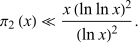
Brun's sieve gives the big-O notation estimate
 |
(3)
|
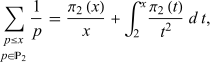
This estimate is strong enough to force convergence. In fact, summation by parts gives
 |
(4)
|
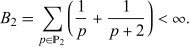
and the bound makes the integral converge as  . Since
  , it follows that
 |
(5)
|
Brun proved the result using a new form of sieve argument (Brun 1919). The conclusion holds whether  is finite or infinite, so the theorem does not decide whether there are infinitely
many twin primes. That assertion is the unproved twin prime conjecture.
is finite or infinite, so the theorem does not decide whether there are infinitely
many twin primes. That assertion is the unproved twin prime conjecture.

 ,
les dénominateurs sont nombres premiers jumeaux est convergente ou finie."
Bull. Sci. Math. 43, 100-104 and 124-128, 1919.Halberstam,
H. and Richert, H.-E.
,
les dénominateurs sont nombres premiers jumeaux est convergente ou finie."
Bull. Sci. Math. 43, 100-104 and 124-128, 1919.Halberstam,
H. and Richert, H.-E.