


The twin prime conjecture refers to two related conjectures. The first version states that there are infinitely many pairs of twin primes (Guy 1994, p. 19). It is not known if there are infinitely many such primes (Wells 1986, p. 41; Shanks 1993, p. 30), but it seems almost certain to be true. While Hardy and Wright (1979, p. 5) note that "the evidence, when examined in detail, appears to justify the conjecture," and Shanks (1993, p. 219) states even more strongly, "the evidence is overwhelming," Hardy and Wright also note that the proof or disproof of conjectures of this type "is at present beyond the resources of mathematics."
Arenstorf (2004) published a purported proof of the conjecture (Weisstein 2004). Unfortunately, a serious error was found in the proof. As a result, the paper was retracted.
The theorem on bounded gaps between primes does not resolve the conjecture. Zhang (2014) proved that the infimum
limit  is finite, and Polymath (2014) established the unconditional bound
  . This gives infinitely many pairs of consecutive
primes separated by at most 246, but it does not show that gap 2 occurs infinitely
often. The twin prime conjecture is the stronger assertion
. This gives infinitely many pairs of consecutive
primes separated by at most 246, but it does not show that gap 2 occurs infinitely
often. The twin prime conjecture is the stronger assertion  .
.
The conjecture that there are infinitely many Sophie Germain primes, i.e., primes  such that
 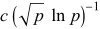 is also prime, is very closely related (Shanks 1993, p. 30).
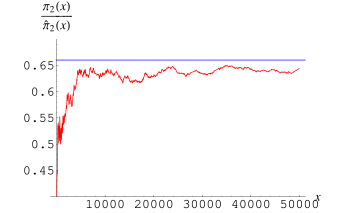
A second twin prime conjecture states that adding a correction proportional to  to a computation of Brun's
constant ending with
to a computation of Brun's
constant ending with  will give an estimate with error less than
  . An extended form of
this conjecture, sometimes called the strong twin prime conjecture (Shanks 1993,
p. 30) or first Hardy-Littlewood
conjecture, states that the number
. An extended form of
this conjecture, sometimes called the strong twin prime conjecture (Shanks 1993,
p. 30) or first Hardy-Littlewood
conjecture, states that the number  of twin primes
  less than or equal to
  is asymptotically equal to
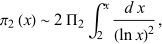 |
where  is the so-called twin primes constant (Hardy
and Littlewood 1923). The value of
is the so-called twin primes constant (Hardy
and Littlewood 1923). The value of  is plotted above for
  , with
  indicated in blue and taking
  .
.
This conjecture is a special case of the more general k-tuple conjecture (also known as the first Hardy-Littlewood
conjecture), which corresponds to the set  .
.
