


An equilateral triangle dissection is a triangle dissection of an equilateral triangle. The constructions below use mutually similar pieces, whose shape can differ from that of the original triangle.
Laczkovich (1995) proved that every dissection of an equilateral triangle into similar
triangles has a tile angle equal to 60 or 120 degrees.
There exists an infinite family realizing the 120-degree case (Pegg 2026). Let  be a positive integer, and let
 be the unique positive real root of
 |
(1)
|
The polynomial has value  at
 and tends to
 as
 , so such a root exists.
Uniqueness follows from Descartes' rule of signs.
The law of cosines shows that a triangle
with sides proportional to
 ,
 , and
 has an included angle of
120 degrees. Copies of this triangle with scale
factors
 ,
 , ...,
 , with the scale factors
 and
 each occurring twice, form a dissection
of an equilateral triangle into
 similar triangles.
Two outer sides have length proportional to
 , while the third has length proportional to
 .
Their equality follows from
 |
(2)
|
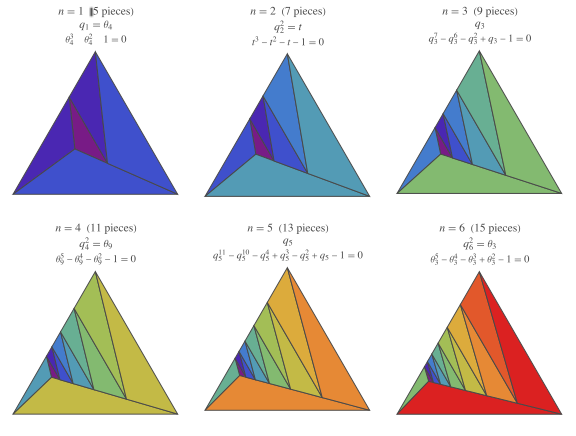
The six cases  , ..., 6 are shown above in reading order. For even
 ,
put
 . Then
 is the unique positive real
root of
 |
(3)
|
The first three roots are the tribonacci constant,  , and
 , respectively, since
 |  |  |
(4)
|
 |  |  |
(5)
|
 |  |  |
(6)
|
The roots  are strictly decreasing. Since
 ,
 |
(7)
|
Since  and
 has only one positive real root by Descartes'
rule of signs, it follows that
 . Now
 lies strictly between the two smallest Pisot
numbers
 and
 , while
 . It follows that
 is a Pisot number precisely
for
 , 2, or 3. Also,
 follows from
 . The construction uses
only the positive real root
of the displayed polynomial, so the Pisot property
is not required.

 Pegg, E. Jr. Mathematical Games. Episode 45: "Filling Space with
Similar Parts." Sep. 24, 2026.