A triangle cubic is a cubic curve associated with a reference triangle. In trilinear
coordinates  ,
its equation is a homogeneous
polynomial of polynomial degree 3 set equal
to zero.
Wells (1991) describes a cubic curve on which 37 notable triangle centers lie. Other triangle cubics include the M'Cay cubic (Gallatly 1913, p. 80) and Thomson cubic (Kimberling 1998, p. 240).
The following table compares eight pivotal isocubics. For a general point  on a pivotal isogonal
cubic,
 ,
its isogonal conjugate, and a fixed pivot
point are collinear. A pivotal
isotomic cubic has the analogous property using the isotomic
conjugate. Here K001, K002, ... are identifiers in Gibert's catalog,
and
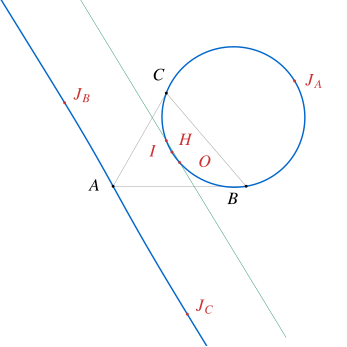
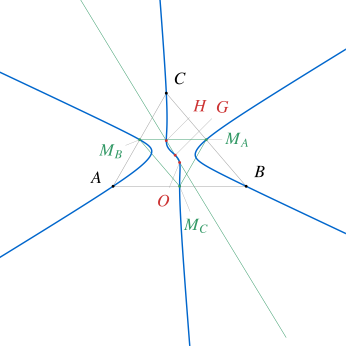
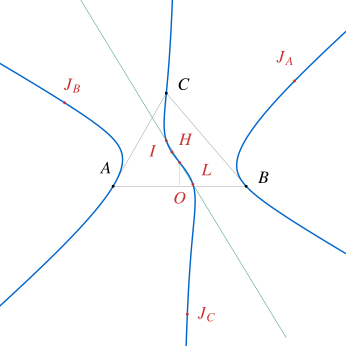
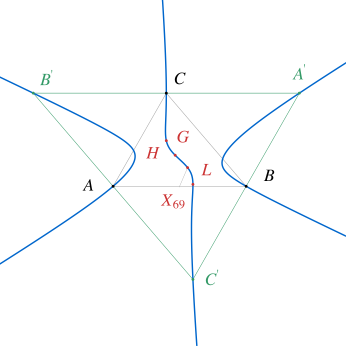
 denotes a Kimberling center. The drawings show
particular reference triangles and are independently
scaled; special triangles can give degenerate curves.
The cubics are blue, the reference
triangles gray, and auxiliary constructions green. Red markers identify selected
labeled triangle centers and excenters.
Thin gray leaders connect offset labels to their points.
Here
 ,
 ,
 ,
 ,
 , and
 denote the circumcenter,
orthocenter, incenter,
triangle centroid, nine-point
center, and de Longchamps point, respectively;
 ,
 , and
 are the excenters opposite
 ,
 , and
 . The green Euler line is shown
for the pivotal isogonal cubics. The Thomson cubic drawing also shows the medial
triangle, with
 ,
 , and
 the midpoints of
 ,
 , and
 . In the pivotal isotomic
cubic drawings,
 ,
 , and
 label the green anticomplementary
triangle. Only finite portions of the curves are shown.
The Euler infinity point has no finite marker,
and the Droussent cubic's pivot
point is outside the displayed region.