


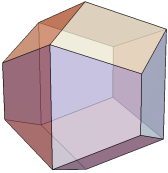
The trapezo-rhombic dodecahedron, also called the rhombo-trapezoidal dodecahedron, is the Voronoi cell of a sphere
center in ideal hexagonal close packing.
Its six identical rhombi and six identical isosceles
trapezoids form a convex, space-filling dodecahedron with  symmetry.
It is implemented in Wolfram Language as PolyhedronData["TrapezoRhombicDodecahedron"].
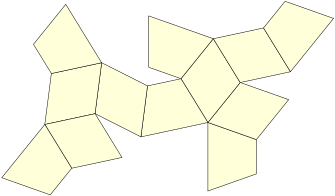
Its net is illustrated above.
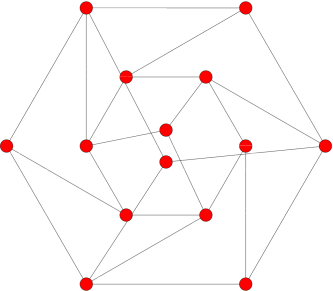
A skeleton based on projecting from along the  symmetry axis
and rotating the inner and central points is illustrated
above.
The Voronoi cells of the sphere centers in face-centered cubic packing are rhombic dodecahedra, while those in ideal hexagonal close packing are trapezo-rhombic dodecahedra (Steinhaus 1999, p. 206).
The trapezo-rhombic dodecahedron can be obtained from the rhombic dodecahedron by cutting through its center perpendicular
to a threefold symmetry axis
and rotating one half  about that axis. The short
and long edges of its trapezoids
have lengths 2/3 and 4/3 times the edge length
of the original rhombic faces.
The top and bottom edge lengths of the constituent trapezoids are  and
 ,
with side lengths (corresponding to the rhombi edge
lengths) of
 . The acute angles
of the trapezoids and rhombi
therefore have angle measure of
 |  |  |
(1)
|
 |  |  |
(2)
|
 |  |  |
(3)
|
(OEIS A137914).
The surface area and volume are given by
 |  |  |
(4)
|
 |  |  |
(5)
|
and the central moment of inertia tensor of the solid with uniform density and mass  by
 |
(6)
|
where  is the
 identity matrix. For unit mass and shortest edge
length
 , this is
 .
