

A trace inequality compares expressions formed from traces of matrices or their matrix
powers. For a Hermitian matrix  with eigenvalues
 , the identity
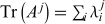 converts polynomial trace inequalities
into inequalities in power sums.
Debus and Schabert (2026) proved that deciding whether a polynomial with rational number coefficients in  ,
 , ...,
 is nonnegative for
every Hermitian matrix of every finite size is
undecidable. Undecidability persists under homogeneity
with respect to scaling
 , giving
 weight
 . For positive
semidefinite matrices, powers 1 through 23 already suffice for undecidability.
These statements use ordinary trace, not trace divided by the matrix size. The matrix
size is unbounded.
