

A superprocess is a measure-valued Markov process that arises as a high-density scaling limit of branching particle systems.
The term measure-valued means that each state  is a random variable
whose possible values are finite measures, rather than
real numbers or points.
For a function
is a random variable
whose possible values are finite measures, rather than
real numbers or points.
For a function  taking only nonnegative values,
 records the mass of
  tested against
  .
.
For a broad class of superprocesses, the conditional Laplace functional has the form
![E_mu[exp(-X_t(f))]=exp(-mu(u_t)),](/images/equations/Superprocess/NumberedEquation1.svg) |
where  is the expected value under the law of the process
with initial state
is the expected value under the law of the process
with initial state  and
and 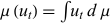 . It is a functional
because its input
. It is a functional
because its input  is a function, and it is conditional because the initial
measure
is a function, and it is conditional because the initial
measure  is fixed. The function
  solves a nonlinear differential
equation describing its evolution in time. The spatial motion supplies the transport
or diffusion part of this equation, while the branching mechanism supplies its nonlinear
term. A basic example, super-Brownian motion,
uses Brownian motion and quadratic branching (Dynkin
1994; Li 2023).
solves a nonlinear differential
equation describing its evolution in time. The spatial motion supplies the transport
or diffusion part of this equation, while the branching mechanism supplies its nonlinear
term. A basic example, super-Brownian motion,
uses Brownian motion and quadratic branching (Dynkin
1994; Li 2023).
