


A sum-free set  is a subset of an additive group
for which the intersection of
 and the sumset
 is empty. The two summands in
 need not be distinct.
For example, the sum-free sets of  are
 ,
 ,
 ,
 ,
 , and
 . The numbers of sum-free
subsets of
 for
 , 1, ... are 1, 2, 3, 6, 9, 16, 24, 42, 61, ... (OEIS
A007865).
The numbers of sum-free sets can be computed in the Wolfram Language using the following code (P. Abbott, pers. comm., Nov. 24, 2005):
NumbersOfSumFreeSets[nmax_] := Module[{n = 0},
    Last[Reap[Nest[(++n; Sow[Length[#]];
      Union[#, Union[#, {n}]& /@
        Select[#, Intersection[#, n - #] == {}&]])&,
          {{}}, nmax + 1]
      ]
    ]
  ]
The Cameron-Erdős conjecture determines the order of growth of the number of sum-free subsets
of  .
A different extremal question asks for the largest sum-free subset guaranteed inside every  -element
set of positive integers.
If this guaranteed size is
 , then Bedert (2025) proved,
for an absolute constant
 ,
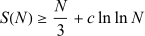 |
for all sufficiently large  . This settles the question whether
the improvement over
 tends to infinity. Eberhard et al. (2014) proved
the complementary leading-order upper bound
 . The precise order of the excess remains
open.
Bedert (2025) also proved a structural theorem. Let  be positive and
 be an
 -element set of nonzero integers
whose largest sum-free subset has size at most
 . Then
 has an
 -Freiman isomorphism
into an interval
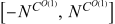 .
This stronger signed-relation convention preserves
 . For every
 ,
 can also be partitioned into pieces
 of size at least
 and an exceptional set
of size
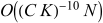 . Each
 has
 and lies in a generalized
arithmetic progression of rank
 and size at most
 . Moreover every subset
 satisfies
 , where
 is its additive energy
(Bedert 2025).
These results allow equal summands in a forbidden equation  . Requiring no element to be the sum
of two or more distinct other elements is a different condition. For example,
 satisfies the distinct-other-summands
condition but is not sum-free because
 . Conversely,
 is sum-free but contains
 .
For the distinct-other-summands convention, let  be the largest size guaranteed in every
 -element set of integers.
Choi et al. (1975) proved
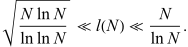 |
In particular, 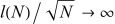 , but the
precise order of growth of
 remains open (Bloom 2026).

 -Estimates for Trigonometric Series." 12 Feb 2025.
 ." Elec. J. Combin. 1, R8, 1994.