TOPICS
Search

Additive Energy


The additive energy of finite subsets A and B of an Abelian group is

 E(A,B)=|{(a_1,a_2,b_1,b_2) in A^2×B^2:a_1+b_1=a_2+b_2}|.
(1)

The additive energy of A is E(A)=E(A,A). If r_(A+B)(x) counts ordered representations of x as a+b, then E(A,B)=sum_(x)r_(A+B)(x)^2. For nonempty A and B, Schwarz's inequality gives

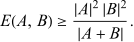
 E(A,B)>=(|A|^2|B|^2)/(|A+B|).
(2)

Thus a small sumset forces large additive energy (Tao and Vu 2006).

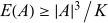
Large additive energy also forces additive structure in a substantial subset. The Balog-Szemerédi-Gowers theorem states that, for K>=1, if A is nonempty and E(A)>=|A|^3/K, then there is A^' subset= A with |A^'|>=cK^(-C)|A| and |A^'-A^'|<=CK^C|A^'|, for absolute constants c,C>0 (Tao and Vu 2006).

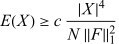
A weighted inverse estimate also follows from a small Fourier norm. Let f(n) be a finitely supported complex-valued function on Z, put F(t)=sum_(n)f(n)e^(2piint), and take its norms on [0,1]. If N>0, ||F||_2<=sqrt(N) and |f(x)|>=1/2 for every x in a finite nonempty X subset Z, then

 E(X)>=c(|X|^4)/(N||F||_1^2)
(3)

for an absolute constant c>0 (Bedert 2025).


See also

Additive Number Theory, Freiman Isomorphism, Sumset

Explore with Wolfram|Alpha

References

Bedert, B. "Large Sum-Free Subsets of Sets of Integers via L^1-Estimates for Trigonometric Series." 12 Feb 2025. https://arxiv.org/abs/2502.08624.Tao, T. and Vu, V. Additive Combinatorics. Cambridge, England: Cambridge University Press, 2006. https://doi.org/10.1017/CBO9780511755149.

Cite this as:

Weisstein, Eric W. "Additive Energy." From MathWorld--A Wolfram Resource. https://mathworld.wolfram.com/AdditiveEnergy.html

Subject classifications