


A subresultant is a polynomial generalizing the resultant of two univariate polynomials. Subresultants provide a way to compute their polynomial greatest common divisor using determinants formed from their coefficients (Collins 1967, Brown and Traub 1971).
Let  have polynomial
degrees
 ,
where
 is a field. For
 , form the matrix
 whose rows are the coefficients
of
 |
(1)
|
with columns in descending powers from  to 1. This matrix has
 rows and
 columns. Let
 consist of its first
 columns followed by its column for
 . The
 th subresultant is
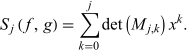 |
(2)
|
It has degree at most  , and each coefficient is a
polynomial in the coefficients
of
 and
 (El Kahoui 2003, pp. 283-285). In particular,
 is the Sylvester matrix,
so
 is the resultant.
With  the leading coefficient of
 , the terminal convention
 |
(3)
|
gives a sequence with  members. When
 , this last member is
 . Other normalizations of the subresultant sequence
are also used.
The principal subresultant coefficient  is the coefficient
of
 in
 . Writing
 , some simple examples are
 |  |  |
(4)
|
 |  |  |
(5)
|
 |  |  |
(6)
|
These are lists of principal subresultant coefficients, rather than lists of the subresultant polynomials themselves. For example, the subresultant polynomial at index 1 for the two quadratic polynomials is
 |
(7)
|
If  is the degree
of the polynomial greatest common
divisor, then all subresultants of index less than
 vanish, and
 is a nonzero scalar multiple of that divisor (El Kahoui
2003, pp. 290-291). Equivalently, the first nonzero principal
subresultant coefficient has index
 . Over an algebraic closure
of
 , this counts common roots
with each multiplicity equal to the smaller of its
multiplicities in
 and
 .
The subresultant polynomials are computed in the Wolfram Language using SubresultantPolynomials[f, g, x], while their principal subresultant coefficients are computed using Subresultants[f, g, x].
