


A structured matrix is a matrix whose entries obey a specified pattern or algebraic relation. Such structure can reduce the number of independent parameters and permit specialized numerical algorithms. Familiar families include Toeplitz matrices, Hankel matrices, Vandermonde matrices, and Cauchy matrices (Pan 2001).
The table compares representative  examples of common patterns and named families. Blue
entries are nonzero, and gray entries are zero. Each
drawing is one example, so additional relations visible in it need not hold for every
member of the class. In the formulas,
 . For a Cauchy matrix,
the parameters are chosen so that
 .
| representative | class | defining pattern |
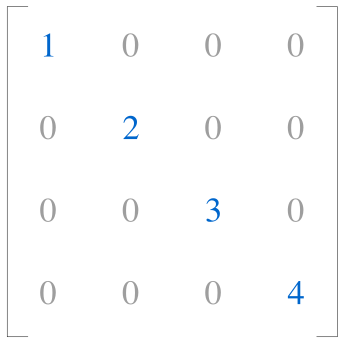
| diagonal matrix |  for  |
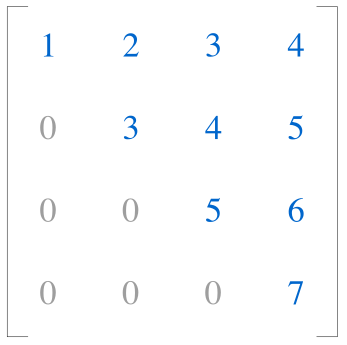
| upper triangular matrix |  for  |
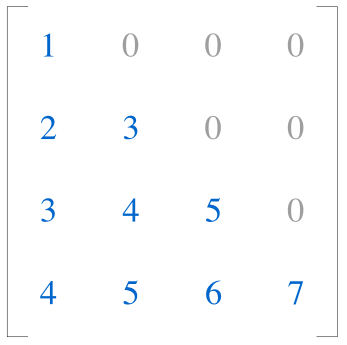
| lower triangular matrix |  for  |
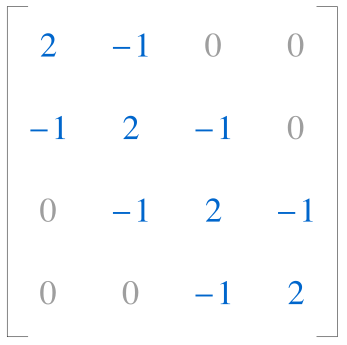
| tridiagonal matrix |  for  |
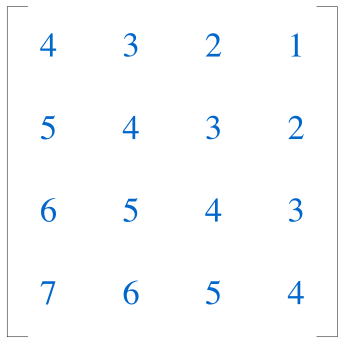
| Toeplitz matrix |  |
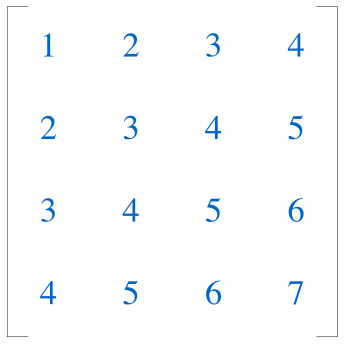
| Hankel matrix |  |
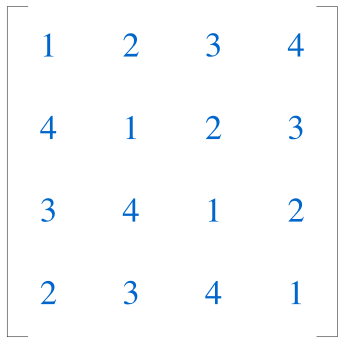
| circulant matrix | each row is a cyclic right shift of the preceding row |
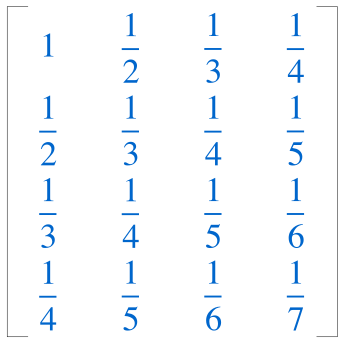
| Hilbert matrix |  |
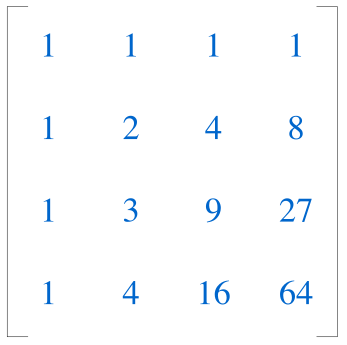
| Vandermonde matrix |  |
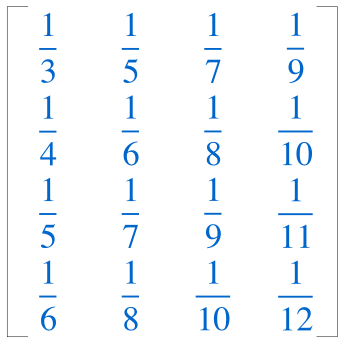
| Cauchy matrix |  |
These classes overlap. A diagonal matrix is both an upper triangular matrix and a lower triangular matrix, and every circulant matrix is a Toeplitz matrix. The Hilbert matrix is both a Hankel matrix and a Cauchy matrix. Structure alone does not guarantee a small condition number, as the Hilbert matrix illustrates. A test matrix is chosen for its role in checking a numerical method and may also belong to one of these structural classes. The name special matrix has a specific meaning for a class of integer matrices.
