


A Hilbert matrix is a matrix  with elements
 |
(1)
|
for  , 2, ...,
 , where
 is a positive integer.
Thus every Hilbert matrix is a rational matrix.
Hilbert matrices are implemented in the Wolfram
Language by HilbertMatrix[n]
or, for a rectangular matrix, by HilbertMatrix[{m,
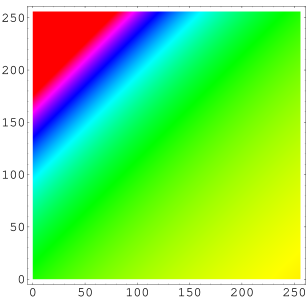
n}]. The figure above shows a plot of the
 Hilbert matrix with elements colored according
to their values.
Hilbert matrices whose entries are specified as machine-precision numbers are difficult to invert using numerical techniques.
The determinants for the first few values of  for
 , 2, ... are given by one divided by 1, 12, 2160,
6048000, 266716800000, ... (OEIS A005249).
Writing
 gives the closed form
 |  |  |
(2)
|
 |  |  |
(3)
|
 |  |  |
(4)
|
where  is the Glaisher-Kinkelin constant and
 is the Barnes
G-function. The numerical values are given in the following table.
 | det( ) |
| 1 | 1 |
| 2 |  |
| 3 |  |
| 4 |  |
| 5 |  |
| 6 |  |
The elements of the matrix inverse of the  Hilbert matrix are given analytically
by
 |
(5)
|
(Choi 1983, Richardson 2001), showing that the matrix inverse is an integer matrix.
A simpler form of the determinant is
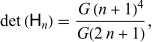 |
(6)
|
where  is the Barnes G-function (Vardi 1988).
An explicit Cholesky decomposition is  , where
 is unit lower triangular
and
 is a diagonal matrix, with
 |  | 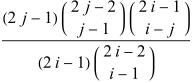 |
(7)
|
 |  | 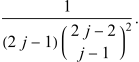 |
(8)
|
The formula for  applies for
 , with
 for
 (Hitotumatu 1988). The lower
triangular factor in the usual Cholesky
decomposition
 is
 .
