


A spectre tile is a strictly chiral aperiodic monotile obtained by suitably modifying the edges
of an equilateral polygon  (Smith et al. 2024). To construct this polygon,
keep the edge directions of the hat polykite and
shorten its length-
 edges to unit length, treating the hat's length-2 side as two consecutive unit edges.
The result has 14 unit edges, two of them consecutive
and collinear.
A spectre tiles the plane and admits only nonperiodic tilings using copies of one handedness, even when reflections are allowed. It therefore solves the strict form of the vampire einstein problem (Smith et al. 2024).
Smith (2023) recalls naming the straight-edged precursor after he and Craig Kaplan noticed that a 30-degree rotation put a tile in the role of a reflected tile in a patch. The name evokes that ghostlike presence.
The straight-edged polygon admits only nonperiodic tilings when only translations and rotations are allowed, but it also admits a periodic tiling when reflections are allowed. It is therefore a weakly chiral aperiodic monotile in the terminology of Smith et al. (2024). By comparison, every tiling by the hat polykite uses both handednesses.
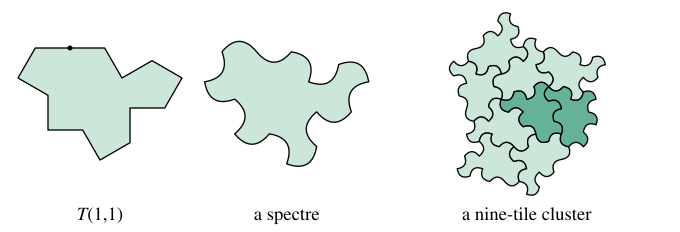
The figure shows  at left, with a dot where its two collinear edges
meet. The middle panel shows a spectre at the same scale, with smooth arcs
that bow alternately inward and outward. The nine-tile cluster at right is drawn
at a smaller scale. The darker pair is the two-tile compound called a Mystic. In
the substitution tiling construction of Smith
et al. (2024), a spectre produces a Mystic and seven single tiles, while a
Mystic produces a Mystic and six single tiles. Every admitted tiling
has a unique hierarchy of such clusters and larger supertiles. Any translational
symmetry would have to preserve the hierarchy, which
rules out a nonzero translation (Smith et al.
2024). Ping (2024) gives a computational construction based on the combinatorially
equivalent tiling by marked hexagons.
