


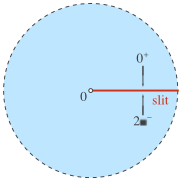
A slit disk is an open disk with a cut extending inward from its boundary. A standard radial example in the complex plane is
 |
(1)
|
where  is the radius.
This removes a full radius, including the center, from
the disk (Aleman et al. 2009, pp. 1-3). More
general slits need not reach the center or be straight.
The radial slit has zero area, so  has the same area
 as the uncut disk. Its two banks
can carry distinct limiting values of a function
approaching the cut from opposite sides. This makes the radial slit useful as a branch cut. For example, with
 , the branch of
the square root
 |
(2)
|
is a conformal mapping from  onto the interior of an upper
half-disk of radius
 . In particular,
 is simply connected.
In torsional rigidity, the full radial cut gives a circular sector with opening angle  whose two radial edges remain separate
free edges (Baksa 2020, p. 85). For a homogeneous, isotropic, linearly elastic
shaft with this cross section, torsional
rigidity is
 ,
where
 is the shear modulus. Integrating the
circular sector solution gives
 |  |  |
(3)
|
 |  |  |
(4)
|
(OEIS A180311) (Timoshenko and Goodier 1951, pp. 278-280). This is smaller than the uncut disk value
 , despite the equal areas,
because the cut changes the boundary conditions.
