

A set with no unique sums is a finite subset  of an Abelian
group, with at least two elements, for which every element of the sumset
 has at least two distinct representations
as an unordered pair of elements of
 . Repeated summands are allowed,
and interchanging the two summands does not give a different representation (Bedert
2024, He 2026, Hou and Yang 2026).
For an odd prime number  , let
 be the least cardinal number
of such a set in the prime field
 (OEIS A398173,
indexed by the successive odd primes starting at
3). This minimum exists because the whole field
has
 unordered representations of each element as a sum of two
field elements. For
 , no such set
exists. Determining the asymptotic order of
 is problem 27 in Green (2025).
For every odd prime number  , elementary bounds give
 |
(1)
|
where  ,
 is the floor function,
and
 is the ceiling function (Hou and Yang 2026).
An explicit construction starts with the balanced set
 |
(2)
|
The sumset  has no unique sums and has at most
 elements (Hou and Yang 2026).
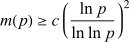
He (2026) proved that an absolute constant  satisfies
 |
(3)
|
for all sufficiently large primes. He (2026) also gives a formal proof in Lean. Hou and Yang
(2026) proved the same lower bound with  for every prime number
 . Their upper bound
is
 |
(4)
|
Consequently,
 |
(5)
|
as  tends to infinity through the primes
(He 2026, Hou and Yang 2026). The question whether
 is bounded below by a positive constant times
 remains open (Hou and Yang 2026).
