

The Sel'kov model is a planar dynamical system for self-sustained oscillations in glycolysis (Sel'kov 1968). A reduced form with a basal reaction term is
 |  |  |
(1)
|
 |  |  |
(2)
|
where primes denote derivatives of  and
 with respect to time
 ,
and
 and
 are positive parameters (Das and Acharyya 2021). At
 , the substitutions
 ,
 , and
 recover Sel'kov's limiting system for reaction exponent
2.
For  , the unique equilibrium
point is
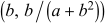 . The Jacobian
matrix there has determinant
 and trace
 . A negative trace
gives an attracting equilibrium point. If the
trace is positive, the equilibrium
point repels, and there is a periodic orbit
in the positive quadrant. Indeed, the vector field
points inward on the boundary away from the origin,
 bounds
 from above, and
 then bounds
 . The Poincaré-Bendixson
theorem gives a periodic orbit from the bounded
trajectories away from the repeller.
