TOPICS
Search

Self-Similar Measure


A self-similar measure is a probability measure invariant under a weighted finite iterated function system of contracting similarities (Hutchinson 1981). On the real line, let phi_i(x)=r_ix+b_i, where 0<|r_i|<1, and choose positive weights p_i summing to 1. Its defining equation is

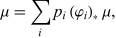
 mu=sum_(i)p_i(phi_i)_*mu,

where the pushforward satisfies (phi_i)_*mu(A)=mu(phi_i^(-1)A). The measure is also the distribution of the random coding limit lim_(n->infty)phi_(I_1) degrees... degreesphi_(I_n)(0), where the symbols I_j are independent random variables with probabilities p_i.

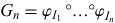
Let G_n=phi_(I_1) degrees... degreesphi_(I_n) be the random composed map. Using natural logarithms in the Shannon entropy H, define

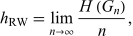
 h_(RW)=lim_(n->infty)(H(G_n))/n,

and let chi=-sum_(i)p_iln|r_i|>0. The Shannon entropy counts distinct composed maps, including their combined probabilities when different addresses coincide.


See also

Bernoulli Convolution, Exact Overlaps Conjecture, Hausdorff Dimension, Iterated Function System, Self-Similarity, Shannon Entropy

Explore with Wolfram|Alpha

References

Hutchinson, J. E. "Fractals and Self-Similarity." Indiana Univ. Math. J. 30, 713-747, 1981. https://doi.org/10.1512/iumj.1981.30.30055.Kittle, S. and Kogler, C. "The Exact Overlaps Conjecture for Self-Similar Measures on the Real Line." 7 Oct 2026. https://arxiv.org/abs/2610.10511.

Cite this as:

Weisstein, Eric W. "Self-Similar Measure." From MathWorld--A Wolfram Resource. https://mathworld.wolfram.com/Self-SimilarMeasure.html

Subject classifications