


The Runge phenomenon is the failure of polynomial interpolation at equally spaced nodes to converge for some smooth functions, with growing oscillations near the ends of the interval as the degree increases. Runge (1901) established that smoothness alone does not ensure convergence for this choice of nodes.
For the Runge function  on
 , the following table compares interpolating
polynomials of degree at most 20, using
21 nodes. The function is shown in black, the interpolant in blue, and the sampled
values in orange. The vertical scales are chosen independently to show the full curves.
| comparison | nodes | positions,  |
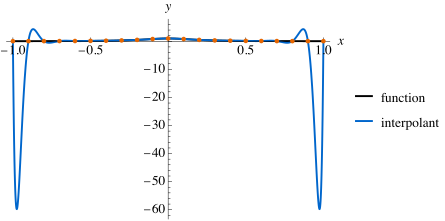
| equally spaced |  |
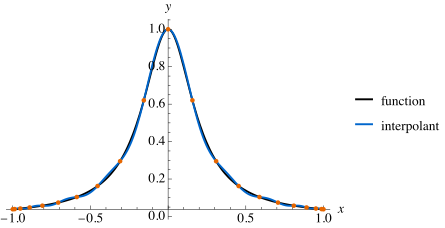
| Chebyshev nodes |  |
The equally spaced interpolants develop large errors near the endpoints, despite matching all the prescribed values. The Chebyshev nodes cluster near the ends of the interval and give convergent interpolation for this function (Trefethen 2019). The obstruction concerns the selected interpolation process, rather than the existence of good approximating polynomials.
