


Regiomontanus' angle maximization problem asks where to place a point on a specified ray to maximize the angle subtended by a fixed line segment. The endpoint of the ray lies on the line containing the line segment, outside that line segment, and the ray is perpendicular to that line. A familiar interpretation asks where an observer should stand to obtain the greatest viewing angle of a picture entirely above eye level (Man 2014).
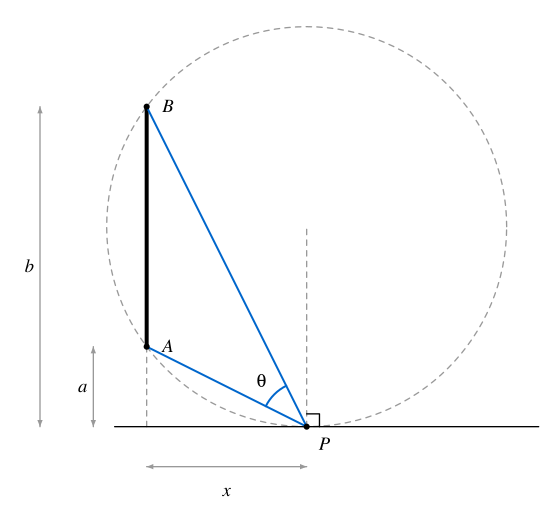
Take the endpoints to be  and
 with
 ,
and let the observer be at
 with
 .
The figure shows the optimal position. The subtended angle
is
 |
(1)
|
where  denotes the inverse
tangent. Since
 ,
maximizing its tangent is equivalent to maximizing the
angle. The trigonometric
addition formulas give
 |
(2)
|
The identity  shows that the unique maximum occurs at
 ,
the geometric mean of the endpoint
offsets. Geometrically, the circle through
 ,
 ,
and the optimal
 has the observer's line as a tangent
line at
 (Man 2014, pp. 38-40).
The same construction gives a planar model for locating a rugby conversion kick (Hughes 1978, Polster and Ross 2010). If the goalposts are separated by  and the permitted line is perpendicular
to the goal line at distance
 from the midpoint of
the posts, then the two offsets are
 and
 .
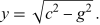
The optimal distance back from the goal line is therefore
 |
(3)
|
As  varies, these positions lie on a rectangular
hyperbola. This model maximizes only the planar angle
between the posts. It does not incorporate the crossbar, ball trajectory, or probability
of a successful kick (Polster and Ross 2010).

 Pegg, E. Jr. "The Statue of Regiomontanus." Wolfram Demonstrations
Project. 2009.