

The reciprocal Fermat constant is the sum of the reciprocals of the Fermat numbers,
 |  |  |
(1)
|
 |  |  |
(2)
|
 |  |  |
(3)
|
 |  |  |
(4)
|
(OEIS A051158), where  is the binary digit sum
of
is the binary digit sum
of  ,
i.e., the number of 1s in its binary expansion,
and
,
i.e., the number of 1s in its binary expansion,
and  is the exponent of 2 in the prime factorization
of
is the exponent of 2 in the prime factorization
of  .
The digit-sum identity is Problem E2455 in Moorthy (1974-1975); see also Finch (2019,
p. 247).
.
The digit-sum identity is Problem E2455 in Moorthy (1974-1975); see also Finch (2019,
p. 247).
Golomb (1963) proved that  is an irrational number,
Duverney (2001) proved that it is a transcendental
number, and Coons (2013) proved that its irrationality
exponent is 2.
is an irrational number,
Duverney (2001) proved that it is a transcendental
number, and Coons (2013) proved that its irrationality
exponent is 2.
The Mellin transform identity
 |
(5)
|
where  is the gamma function and
  is the Riemann zeta
function, is valid for
is the Riemann zeta
function, is valid for  (NIST DLMF, eqn. 25.5.3). Applying the inverse
Mellin transform at
(NIST DLMF, eqn. 25.5.3). Applying the inverse
Mellin transform at  and summing the geometric
series
and summing the geometric
series  gives the contour representation
 |
(6)
|
where  is a real number.
A number is disjunctive in base  if its base-
 expansion contains every finite word over the digits 0, 1,
...,
expansion contains every finite word over the digits 0, 1,
...,  .
Equivalently, the sequence of fractional parts
.
Equivalently, the sequence of fractional parts  is dense modulo 1. Every normal number is disjunctive,
but the converse need not hold (Leśniak 2014).
is dense modulo 1. Every normal number is disjunctive,
but the converse need not hold (Leśniak 2014).
CaptainSude (2026) gives an AI-generated argument claiming that  is disjunctive but not normal
in base 2, and that every finite binary word occurs with positive lower frequency.
It also treats the family
is disjunctive but not normal
in base 2, and that every finite binary word occurs with positive lower frequency.
It also treats the family
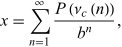 |
(7)
|
where  ,
,
 is a nonconstant polynomial whose coefficients
are integers, and
is a nonconstant polynomial whose coefficients
are integers, and  is the greatest integer
  for which
  divides
  .
The claim states that every such
.
The claim states that every such  is base-
 disjunctive and nonnormal. The release includes a Lean 4 check;
independent specialist review had not been reported as of Sep. 9, 2026 (CaptainSude
2026, VibeMathed 2026).
disjunctive and nonnormal. The release includes a Lean 4 check;
independent specialist review had not been reported as of Sep. 9, 2026 (CaptainSude
2026, VibeMathed 2026).
