

A binary expansion of a nonnegative real number  is a base-2
representation
is a base-2
representation
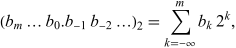 |
where  is a nonnegative integer and each binary
digit
is a nonnegative integer and each binary
digit  is either 0 or 1. For example,
  ,
,  , and
, and 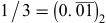 .
.
Negative numbers are not covered by this definition. Their representation requires an additional convention. In ordinary mathematical
notation, a minus sign is often placed before a binary numeral. For example,
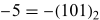 . This is a notation convention,
not part of the positional expansion above. In contrast, negabinary,
which uses base
. This is a notation convention,
not part of the positional expansion above. In contrast, negabinary,
which uses base  , represents every integer uniquely
by a finite string of the digits 0 and 1 and requires no
separate sign.
, represents every integer uniquely
by a finite string of the digits 0 and 1 and requires no
separate sign.
A fixed-width computer representation of a negative integer instead requires an encoding convention. Common choices are sign-and-magnitude representation, ones' complement, and two's complement.
A nonnegative rational number has an eventually periodic binary expansion, and every eventually
periodic binary expansion represents a nonnegative rational
number. If  is a reduced fraction, then its binary expansion
terminates iff
is a reduced fraction, then its binary expansion
terminates iff  is a power of 2.
Every positive real number with a terminating binary expansion also has a nonterminating binary expansion whose
binary digits are eventually all 1s. For example,
 . Apart from
leading zeros, pairs of this form account for all nonuniqueness
of binary expansions.
. Apart from
leading zeros, pairs of this form account for all nonuniqueness
of binary expansions.
For  ,
the Mersenne number
,
the Mersenne number  has binary expansion
  with
with  binary digits, all equal to
1, and is therefore a binary repunit.
binary digits, all equal to
1, and is therefore a binary repunit.
The binary expansion of a number  can be obtained in the Wolfram
Language using RealDigits[x,
2].
can be obtained in the Wolfram
Language using RealDigits[x,
2].
