

A random perceptron is a model of random linear measurements of a weight vector, with constraints or weights imposed through a scalar function of each measurement. For independent
pattern vectors  with independent standard normal coordinates, a common
measurement convention is
 . At pattern density
 , there are
 patterns, with
 the floor function.
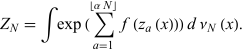
For a single-pattern log-weight
 , its partition
function is
 |
The Ising perceptron uses uniform probability on binary weight vectors, and the spherical
perceptron uses uniform probability on a sphere
of radius  . Hard constraints instead assign zero weight to vectors
violating a prescribed measurement inequality. The
geometry of the weight space and the pattern distribution are part of the model.
