

A Gibbs measure is a probability measure obtained by weighting a reference measure with the exponential
of an energy function. For energy  , inverse temperature
 , and reference measure
 , its finite-system form is
 |
where 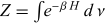 is finite and positive. The
normalizing quantity
 is the statistical-mechanical
partition function. Changing from counting measure
to uniform probability on
 divides
 by
 without changing
 .
This lowers the thermodynamic pressure
by
 .
For an infinite lattice with finite-range interactions, a Gibbs measure is specified by requiring its conditional law in every finite region, given the spins outside, to have this form with the corresponding boundary interaction. The Ising model and the O(n) model use discrete and spherical spin reference measures, respectively. Glauber dynamics resamples spins from the conditional probabilities of a Gibbs measure.
