TOPICS
Search

Radical Equation


A radical equation is an equation in which an unknown occurs in the radicand of a radical (Marecek and Mathis 2020).

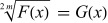
Let F and G be real functions on a common domain, and let m be a positive integer. With the even root taken to be nonnegative, the radical equation RadicalBox[{F, {(, x, )}}, {2, m}]=G(x) is equivalent to the simultaneous conditions
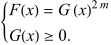
 {F(x)=G(x)^(2m); G(x)>=0.
(1)

The sign condition retains the choice of principal root. Raising to an even power without this condition can introduce extraneous solutions (Gelfand and Shen 1993, pp. 96 and 99).

For equations built from rational functions and radicals, introducing auxiliary variables replaces the radicals by polynomial equations. The original denominators must remain nonzero, and the auxiliary variables must retain the sign and domain restrictions selecting the intended roots. For complex principal roots, the chosen branch must also be imposed.


See also

Equation, Extraneous Solution, Polynomial Equation, Principal Root, Radical

Explore with Wolfram|Alpha

References

Gelfand, I. M. and Shen, A. Algebra. Boston, MA: Birkhäuser, pp. 94, 96, and 99, 1993.Marecek, L. and Mathis, A. H. "Solve Radical Equations." §8.6 in Intermediate Algebra, 2nd ed. Houston, TX: OpenStax, 2020. https://openstax.org/books/intermediate-algebra-2e/pages/8-6-solve-radical-equations.Trott, M. "Solution of Equations." §1.5 in The Mathematica GuideBook for Symbolics. New York: Springer-Verlag, 2006. https://doi.org/10.1007/0-387-28815-5. https://www.mathematicaguidebooks.org/.

Cite this as:

Weisstein, Eric W. "Radical Equation." From MathWorld--A Wolfram Resource. https://mathworld.wolfram.com/RadicalEquation.html

Subject classifications