

Quantum entanglement is the failure of a joint quantum state to be expressible as a convex combination
of product states. For finite-dimensional Hilbert
spaces  and
and  ,
a density matrix
,
a density matrix  is separable when it can be written
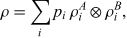 |
with  ,
,
 ,
and density matrices
,
and density matrices  and
and  . A state that is not separable is entangled. A pure
state is separable precisely when its defining unit vector
is a tensor product.
. A state that is not separable is entangled. A pure
state is separable precisely when its defining unit vector
is a tensor product.
For example,  is an entangled pure state of two quantum bits. The Greenberger-Horne-Zeilinger state
is a multipartite example that is entangled across every nontrivial bipartition.
The unentanglement promise in QMA(2) and the approximation problem in the no-disentanglers
conjecture depend on this distinction between separable states and arbitrary
joint states.
is an entangled pure state of two quantum bits. The Greenberger-Horne-Zeilinger state
is a multipartite example that is entangled across every nontrivial bipartition.
The unentanglement promise in QMA(2) and the approximation problem in the no-disentanglers
conjecture depend on this distinction between separable states and arbitrary
joint states.
