


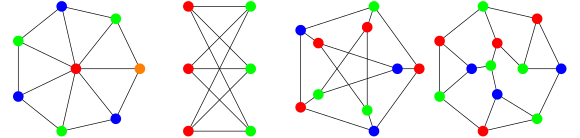
A vertex coloring is an assignment of labels or colors to the vertices of a graph such that the endpoints of every edge
receive different colors. The most common type of vertex coloring seeks to minimize
the number of colors for a given graph. Such a coloring
is known as a minimum vertex coloring,
and the minimum number of colors with which the vertices
of a graph  may be colored is called the chromatic
number, denoted
may be colored is called the chromatic
number, denoted  .
Finding a minimum vertex coloring is the
vertex coloring problem.
.
Finding a minimum vertex coloring is the
vertex coloring problem.
In this sense, a vertex coloring is a proper coloring. A graph whose vertices are assigned arbitrary colors or labels, without requiring adjacent vertices to have distinct colors, is instead a vertex-colored graph.
A vertex coloring of a graph with  or fewer colors is known as a k-coloring.
A graph having a k-coloring
(and therefore chromatic number
or fewer colors is known as a k-coloring.
A graph having a k-coloring
(and therefore chromatic number  ) is said to be a k-colorable
graph, while a graph having chromatic
number
) is said to be a k-colorable
graph, while a graph having chromatic
number  is called a k-chromatic graph. The only
one-colorable (and therefore one-chromatic) graphs are empty
graphs, and two-colorable graphs are exactly the bipartite
graphs. The four-color theorem establishes
that all planar graphs are 4-colorable.
is called a k-chromatic graph. The only
one-colorable (and therefore one-chromatic) graphs are empty
graphs, and two-colorable graphs are exactly the bipartite
graphs. The four-color theorem establishes
that all planar graphs are 4-colorable.

 -Colorings
of a Graph on a Fixed Surface." Disc. Math. 306, 3145-3153, 2006.
-Colorings
of a Graph on a Fixed Surface." Disc. Math. 306, 3145-3153, 2006.