

The principal matrix power  of a square complex matrix
 with no eigenvalue
on
![(-infty,0]](/images/equations/PrincipalMatrixPower/Inline3.svg) is the matrix obtained by applying the branch
 , with
 , to the Jordan
canonical form of
 (Higham 2008). Here
 is real,
 is the natural logarithm,
and
 is the complex argument.
For a Jordan block  of size
 , where
 , the definition is
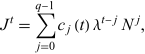 |
where  and
 for
 .
For
 ,
it gives
 |
The result is independent of the chosen Jordan canonical form and agrees with ordinary matrix powers
for integer  . This construction does not mean entrywise exponentiation.
A real P-matrix has no eigenvalue on ![(-infty,0]](/images/equations/PrincipalMatrixPower/Inline18.svg) ,
so all its principal real powers are defined. Such powers need not remain P-matrices
in orders at least 4 (Xie 2026).

 -Matrices." 25 Oct 2026.