

The powerful part  of a positive integer
 is its largest divisor which is
a powerful number. In terms of the prime
factorization
 , it is
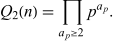 |
(1)
|
The complete prime power  is retained whenever
 . For example,
 and
 . The quotient
 is squarefree and relatively prime to
 .
Erdős's problem 935 asks whether, for every fixed integer  and every
 , all sufficiently large
 satisfy
 |
(2)
|
This remains open (Bloom 2026). The exponent 2 is a natural boundary: a classical result of Mahler implies that the supremum limit
after division by  is at least 1 for each
 (Bloom 2026).
A Pell equation construction gives the stronger statement
 |
(3)
|
for every fixed  (van Doorn, reported in Bloom 2026). Veljjanoski (2026) gives Lean proofs
of this conclusion and the Mahler lower bound, with
published kernel acceptance recorded by the Palomar Registry. These statements concern
the powerful part of the entire product, which need not equal the product of the
individual powerful parts. They do not settle the separate conjecture that three
consecutive powerful numbers do not exist.
It is also open whether  for each fixed
 (Bloom 2026). The restriction excludes
 , for which infinitely many
products
 are themselves powerful.
