


The perfect matching cover index of a graph  is the minimum number of perfect
matchings whose union contains every edge of
is the minimum number of perfect
matchings whose union contains every edge of  .
It is also called the perfect matching index and the excessive index, and is often
denoted
.
It is also called the perfect matching index and the excessive index, and is often
denoted  in the perfect matching index literature (Máčajová and Škoviera
2021).
in the perfect matching index literature (Máčajová and Škoviera
2021).
Petersen's theorem implies that every bridgeless cubic graph has a perfect matching, and extensions of the theorem imply that every bridgeless cubic graph has finite perfect matching cover index. For a bridgeless cubic graph,
 |
with equality iff  is 3-edge colorable.
Berge's conjecture asserts that
 |
for every bridgeless cubic graph  .
This conjecture is equivalent to the Fulkerson
conjecture (Mazzuoccolo 2011). A snark therefore has
perfect matching cover index 4 or 5 if Berge's
conjecture holds.
.
This conjecture is equivalent to the Fulkerson
conjecture (Mazzuoccolo 2011). A snark therefore has
perfect matching cover index 4 or 5 if Berge's
conjecture holds.
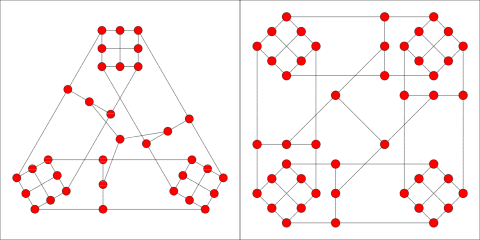
The 34- and 46-vertex perfect matching snarks, illustrated above, cannot be covered with four perfect matchings, and have perfect matching cover index 5. These Halin snarks will be implemented in a future version of the Wolfram Language as GraphData["PerfectMatchingSnark34"] and GraphData["PerfectMatchingSnark46"].
A cubic graph has its edges covered with four perfect matchings iff it admits a tetrahedral flow, namely a
nowhere-zero  -flow whose edge values are points of a tetrahedron in
  and whose values around each vertex form a line of that tetrahedron (Máčajová
and Škoviera 2021).
and whose values around each vertex form a line of that tetrahedron (Máčajová
and Škoviera 2021).
