

A Halin snark is a snark constructed from a cubic Halin graph by replacing the vertices of its perimeter cycle with auxiliary graph multipoles. The graph multipoles used by Máčajová and Škoviera (2021) are derived from a cubic graph with perfect matching cover index at least 5 and a bipartite cubic graph.
Every Halin snark has perfect matching cover index at least 5. When the fragments are constructed from cyclically 4-edge-connected cubic graphs of girth at least 5, the resulting Halin snarks are nontrivial snarks, i.e., cyclically 4-edge-connected cubic graphs of girth at least 5.
The family of Halin snarks contains the previously known nontrivial snarks with perfect matching cover index at least
5, including treelike snarks, windmill snarks, and the family constructed by Chen
(Máčajová and Škoviera 2021). In particular, for every
even integer  ,
there exists a nontrivial snark on
,
there exists a nontrivial snark on  vertices with perfect
matching cover index at least 5. The existence of nontrivial snarks of orders
38 and 40 with perfect matching cover index
at least 5 remains open.
vertices with perfect
matching cover index at least 5. The existence of nontrivial snarks of orders
38 and 40 with perfect matching cover index
at least 5 remains open.
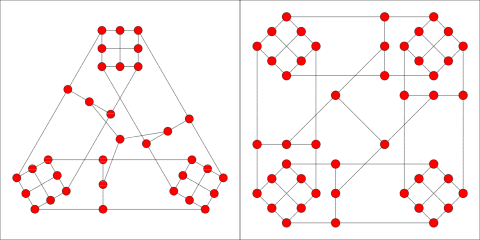
The 34- and 46-vertex perfect matching snarks, illustrated above, are Halin snarks that cannot be covered with four perfect matchings and have perfect matching cover index 5. They will be implemented in a future version of the Wolfram Language as GraphData["PerfectMatchingSnark34"] and GraphData["PerfectMatchingSnark46"].
The 46-vertex perfect matching snark has graph crossing number 12.
