


The pentakis dodecahedron is the 60-faced dual polyhedron of the truncated icosahedron (Holden 1971,
p. 55). It can be constructed by augmentation
of a unit edge-length dodecahedron by a pyramid
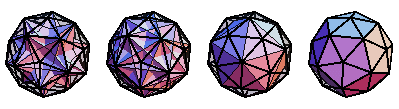
with height  . It is illustrated above
together with a wireframe version and a net that can be used
for its construction.
It is Wenninger dual  .
A tetrahedron 10-compound, cube 5-compound, icosahedron, and dodecahedron can be inscribed in the vertices of the pentakis dodecahedron (E. Weisstein, Dec. 25-27, 2009).

The pentakis dodecahedron is the convex hull of the small triambic icosahedron hull.
Taking the dual of a truncated icosahedron with unit edge lengths gives a pentakis dodecahedron with edge lengths
 |  |  |
(1)
|
 |  |  |
(2)
|
Normalizing so that  , the surface
area and volume are
 |  |  |
(3)
|
 |  |  |
(4)
|

The pentakis dodecahedron is a Rupert polyhedron. The figure above shows a congruent copy passing without turning through a straight tunnel. Steininger and Yurkevich (2023) give placement parameters with an attained linear enlargement factor of 1.001845, a lower bound for its Nieuwland number. This passage uses the dual polyhedron of the truncated icosahedron, rather than the inscribed realization discussed below.

Hoehner (2026) considered the problem of maximizing volume among convex polyhedra with at most 32 vertices on the unit sphere. The unique maximizer, up to orthogonal transformations, is the inscribed pentakis dodecahedron illustrated above. Its 60 faces are congruent isosceles triangles, with different proportions from those of the dual of the truncated icosahedron.
The maximizer is the convex hull of the 12 vertices of a regular icosahedron on the unit
sphere together with the radial projections of the centers
of its 20 faces onto the sphere.
The full symmetry group is the icosahedral
group  , of group order 120.
Its volume is
 |  |  |
(5)
|
 |  |  |
(6)
|
(OEIS A395323).
