

The paper bag problem asks for the maximum volume enclosed by a sealed bag formed from two congruent rectangles
of side lengths  joined along their boundaries, under the assumption that the material can bend but
not stretch. An empirical estimate for the maximum volume
is
joined along their boundaries, under the assumption that the material can bend but
not stretch. An empirical estimate for the maximum volume
is
![V=a^3[b/(pia)-0.142(1-10^(-b/a))].](/images/equations/PaperBagProblem/NumberedEquation1.svg) |
(1)
|
(Robin 2004).
More generally, Pak and Schlenker (2010) considered the profiles of inflated convex polyhedra and other almost everywhere flat surfaces having a plane of symmetry. Such profiles belong to a one-parameter family of curves characterized by the solutions of an ordinary differential equation.
For a finite rectangular pneumatic pouch, Li et al. (2026) approximated the inflated shape by the intersection of two orthogonal extrusions of circular arcs.
For a minor arc with radius  , chord
length
, chord
length  ,
and arc length
,
and arc length  , its sagitta profile
in chord-centered coordinates for
, its sagitta profile
in chord-centered coordinates for  is
is
 |
(2)
|
where  is determined implicitly by
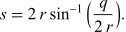 |
(3)
|
The denominator  is required for the flat-arc limit; equation (6) of Li et al. (2026) instead
prints
is required for the flat-arc limit; equation (6) of Li et al. (2026) instead
prints  .
Writing
.
Writing  and
and  for the two orthogonal profiles, with
  , the height of the upper half of the approximate
pillow surface is
, the height of the upper half of the approximate
pillow surface is
 |
(4)
|
and its enclosed volume is therefore
 |
(5)
|
This circular-arc construction is an engineering approximation rather than an exact solution of the paper bag problem. For pouches with nominal dimensions 14 mm by 28 mm, it predicted a contraction of 27.4%, compared with 27.1% measured experimentally (Li et al. 2026).
