

An outer-cylindrical graph is a graph having a planar graph embedding for which all graph vertices lie collectively on the boundaries of at most two graph faces. Every outerplanar graph is therefore outer-cylindrical.
The class of outer-cylindrical graphs is closed under taking graph minors. An outer-cylindrical forbidden minor is therefore a graph that is not outer-cylindrical but for which every proper graph minor is outer-cylindrical. Archdeacon et al. (2001) found the following 38 forbidden minors, which give an excluded-minor characterization.
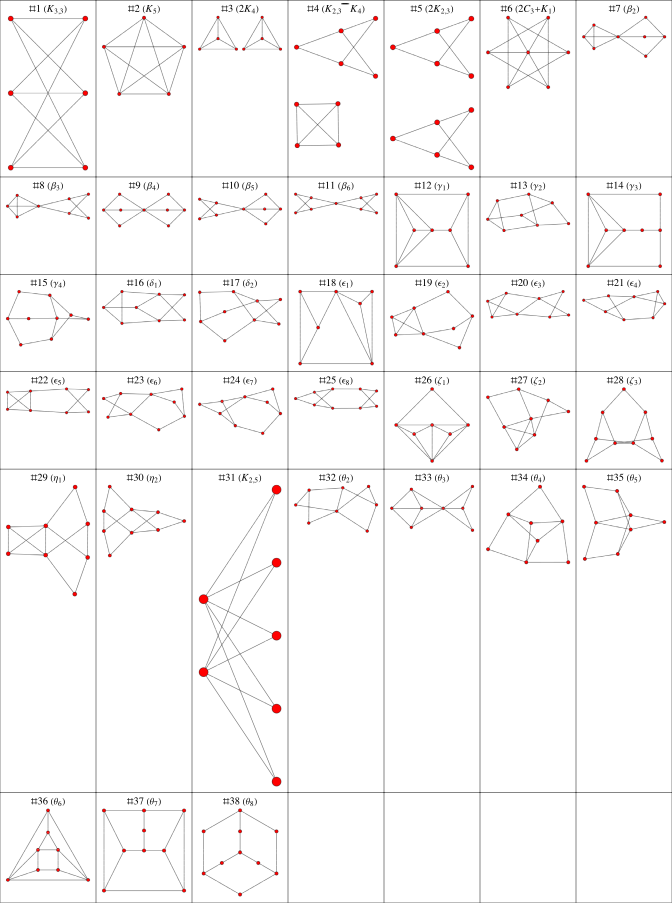
The 38 outer-cylindrical forbidden minors are illustrated above. Their numbering and notation are summarized below.
| number | notation | number | notation |
| 1 |  | 20 |  |
| 2 |  | 21 |  |
| 3 |  | 22 |  |
| 4 |  | 23 |  |
| 5 |  | 24 |  |
| 6 |  | 25 |  |
| 7 |  | 26 |  |
| 8 |  | 27 |  |
| 9 |  | 28 |  |
| 10 |  | 29 |  |
| 11 |  | 30 |  |
| 12 |  | 31 |  |
| 13 |  | 32 |  |
| 14 |  | 33 |  |
| 15 |  | 34 |  |
| 16 |  | 35 |  |
| 17 |  | 36 |  |
| 18 |  | 37 |  |
| 19 |  | 38 |  |
The  th
outer-cylindrical forbidden minor will be implemented
in a future version of the Wolfram Language
as GraphData[
th
outer-cylindrical forbidden minor will be implemented
in a future version of the Wolfram Language
as GraphData[ "OuterCylindricalForbiddenMinor",
n
"OuterCylindricalForbiddenMinor",
n ]
for
]
for  ,
2, ..., 38.
,
2, ..., 38.
Outer-cylindrical graphs characterize certain graph Cartesian products that admit a torus graph
embedding. More precisely, let  and
and  be nontrivial simple graphs
that are connected, and suppose
be nontrivial simple graphs
that are connected, and suppose  is 3-connected. Then
 admits a torus graph embedding iff
  is outer-cylindrical and
  (Badgett et al. 2026).
