


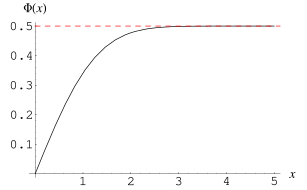
The normal distribution function gives the probability that a variate from the standard normal distribution assumes a value in the
range ![[0,x]](/images/equations/NormalDistributionFunction/Inline1.svg) ,
,
 |
(1)
|
It is related to the probability integral
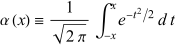 |
(2)
|
by
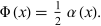 |
(3)
|
Let  so
so 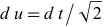 .
Then
.
Then
 |
(4)
|
Here, erf is a function sometimes called the error function. The probability that a normal variate assumes a value in the range ![[x_1,x_2]](/images/equations/NormalDistributionFunction/Inline4.svg) is therefore given by
is therefore given by
![Phi(x_1,x_2)=1/2[erf((x_2)/(sqrt(2)))-erf((x_1)/(sqrt(2)))].](/images/equations/NormalDistributionFunction/NumberedEquation5.svg) |
(5)
|
Neither  nor erf can be expressed in terms of finite additions, subtractions,
multiplications, and root extractions, and so
must be either computed numerically or otherwise approximated.
nor erf can be expressed in terms of finite additions, subtractions,
multiplications, and root extractions, and so
must be either computed numerically or otherwise approximated.
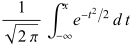
Note that a function different from  is sometimes defined as "the" normal distribution
function
is sometimes defined as "the" normal distribution
function
 |  |  |
(6)
|
 |  |  |
(7)
|
 |  |  |
(8)
|
 |  | ![1/2[1+erf(x/(sqrt(2)))]](/images/equations/NormalDistributionFunction/Inline18.svg) |
(9)
|
(Feller 1968; Beyer 1987, p. 551), although this function is less widely encountered than the usual  . The notation
  is due to Feller (1971).
The value of  for which
  falls within the interval
 ![[-a,a]](/images/equations/NormalDistributionFunction/Inline23.svg) with a given probability
with a given probability  is a related quantity called the confidence
interval.
is a related quantity called the confidence
interval.
For small values  , a good approximation to
  is obtained from the Maclaurin
series for erf,
is obtained from the Maclaurin
series for erf,
 |
(10)
|
(OEIS A014481). For large values  , a good approximation is obtained from the asymptotic
series for erf,
, a good approximation is obtained from the asymptotic
series for erf,
 |
(11)
|
(OEIS A001147).
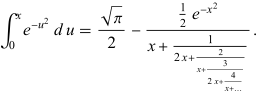
The value of  for intermediate
  can be computed using the continued
fraction identity
can be computed using the continued
fraction identity
 |
(12)
|
A simple approximation of  which is good to two decimal places is given by
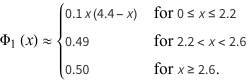 |
(13)
|
Abramowitz and Stegun (1972) and Johnson et al. (1994) give other functional approximations. An approximation due to Bagby (1995) is
![Phi_2(x)=1/2{1-1/(30)[7e^(-x^2/2)+16e^(-x^2(2-sqrt(2)))+(7+1/4pix^2)e^(-x^2)]}^(1/2).](/images/equations/NormalDistributionFunction/NumberedEquation10.svg) |
(14)
|
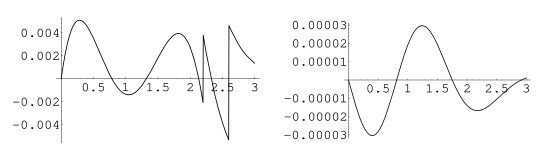
The plots below show the differences between  and the two approximations.
The value of  giving
  is known as the probable error
of a normally distributed variate.
is known as the probable error
of a normally distributed variate.
