

Multistochastic optimal transport optimizes the integral of a cost over probability measures on a product space whose marginals on every specified collection
of  coordinates are fixed. For
 coordinates and
 ,
it is called the
 problem; ordinary optimal
transport corresponds to
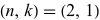 (Gladkov et al. 2019). In the
 case with all two-coordinate marginals equal to uniform
distributions on
 ,
the three coordinates are pairwise independent
and uniform.
Write a binary expansion  ,
 , and let
 |
(1)
|
For independent random variables  with uniform distribution, Gvozdev and Kolesnikov
(2026) proved that among all pairwise independent
uniform triples, the choice
 minimizes
 , while
 maximizes it. The symbol
 means exclusive OR of corresponding binary digits;
ambiguities at numbers with two binary expansions
have probability zero. The minimizing plan is supported
on the tetrix with vertices
 ,
 ,
 , and
 .
The maximizing plan lies on its reflection with vertices
 ,
 ,
 , and
 .
The case
 , whose coefficients satisfy equality instead of
the strict domination above, was established separately by Gladkov et al. (2019).
For the geometric coefficients  ,
 , Gvozdev and Kolesnikov (2026) also constructed
a dual certificate. Put
 ,
 , and
 . On sequences of binary
digits, let
 delete the first digit if it is 1, and delete the first digit
and complement all remaining digits if it is 0. The bounded function
 |
(2)
|
satisfies
 |
(3)
|
with equality for  .
Integrating the left side depends only on the fixed two-coordinate marginals, which
certifies minimality for the centered cost. The authors report that GPT-6 Astra contributed
to developing these dual solutions, whose arguments they checked.
