

The multiplication table problem asks for the growth of the number of distinct products in the  multiplication
table (Erdős 1955, Ford 2008). The count is
 |
(1)
|
For  , 2, ..., the first values are 1, 3, 6, 9, 14, 18,
25, 30, 36, 42, ... (OEIS A027424). A positive
integer
 occurs precisely when it has a divisor in
 .
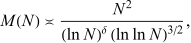
Ford (2008) determined the order of growth
 |
(2)
|
where  (OEIS A074738) and
 means that the ratio stays between positive constants for
all sufficiently large
 .
The same exponent occurs in the mean-value estimate
for the shorter side of a minimum-surface
integral box in dimension two.
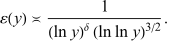
The proof uses estimates for integers with a divisor in a prescribed interval. If  is the natural density
of integers with a divisor in
 , Ford (2008) gives
 |
(3)
|
For each fixed positive integer  , the natural density
of integers with exactly
 divisors in this interval
is bounded below by a positive constant times
 for all sufficiently large
 , with the constant allowed to depend on
 . In particular, the proportion with exactly one divisor among those with at least one does not tend to zero.
These results answer problem 446
in the Erdős problems collection. Ford uses
![(y,2y]](/images/equations/MultiplicationTableProblem/Inline15.svg) . When
 is an integer, removing that
endpoint changes each natural density by at most
 .
