

A minimum-surface integral box of volume  in dimension
 is an orthotope with positive integer edge lengths
 of product
 that minimizes the total
 -dimensional surface area.
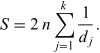
At fixed
 , this amounts to minimizing the sum
of the reciprocals of the lengths, since the surface
area is
 |
(1)
|
In dimension two, the surface area is the perimeter of a rectangle. Writing the short side as  , the perimeter
is
 , which decreases as
 increases to
 .
Thus the unique pair consists of the greatest divisor
of
 at most
 and the least divisor of
 at least
 .
The shorter lengths start 1, 1, 1, 2, 1, 2, 1, 2, 3, ... (OEIS A033676),
and the longer lengths start 1, 2, 3, 2, 5, 3, 7, 4, 3, ... (OEIS A033677)
(Tenenbaum 1976).
For cuboids of volume  , 2, ..., the minimum surface
areas are 6, 10, 14, 16, 22, 22, 30, 24, 30, 34, 46, 32, ... (OEIS A075777).
If the volume is allowed to be at least
 , the corresponding half-areas start 3, 5, 7, 8, 11,
11, 12, 12, 15, 16, 16, 16, ... (OEIS A400004).
For instance, volume 7 forces dimensions
 and surface area
30, whereas volume at least 7 permits a cube
of volume 8 with surface area
24.
Rotgé and Tenenbaum (2026) report numerical uniqueness for  , 4, and 5 through
 . In dimensions
 , whether the sorted minimizing tuple is always
unique remains open. For fixed
 ,
their mean-value estimates hold for any choice of minimizing tuple
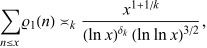
 . Put
 and
 .
The sum of the shortest lengths satisfies
 |
(2)
|
where  denotes upper and lower bounds by positive constant multiples depending only on
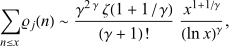
 . For
 ,
with
 , the corresponding asymptotic
formula is
 |
(3)
|
where  is the Riemann zeta function.
